More Whytecliff!
Mihai came out on this dive, and we did the left islet like Jason and I had done the previous dive. It was again a nice dive. There are a lot of underwater cables stretching down from the island into the depths, and many of them are totally encrusted with life. Feathery tube worms were the coolest things, along with several painted greenlings.
Mihai had some problems with his sinuses, and couldn't do the second dive. I ended up tagging along with a beginning open water class and just hanging out watching them doing a few skills of my own. It wasn't a bad dive, and I think the students appreciated seeing a "real" diver!
Thursday, July 1, 2010

Whytecliff – 13/06/2010
Jason wanted to practice rescue diver skills, and that was our goal today.
Our first dive we went and explored the left side of the bay along the island. I'd not been out that way before, and it turned out to be very pleasant. You can actually circle the island, but it takes quite a bit of time. Our dive was more conservative, and we just went out then turned back at our agreed-on turn pressure. We saw a really interesting fish, which turned out to be a longfin sculpin.
http://farm1.static.flickr.com/203/519431004_09f999f2b9.jpg?v=0
I thought for sure it was something strange, but they are very common.
For our rescue skills, we practiced surfacing an unresponsive diver. We took turns and surfaced the other 3 times total. I was in my doubles, so it was a challenge both for me and Jason. Me in that I had to deal with the extra bulk, and he to deal with the extra weight. We agreed that we did pretty well. Slow controlled ascents on almost all attempts.
At the end, we tried to see if we could swim up against the weight of our gear, to simulate a wing failure. Jason was just able to, but there was no way I could swim up against the weight of my doubles. It was a good thing to find out. But not a big concern, as with the setup I have, the chances of both the wing and your drysuit failing at the same time is virtually zero.
Howe Sound Boat Dive - 06/06/2010
This boat dive with the Topline was very good. I was out with Mihai and Vince, and we were all on single steel 100s.
The previous week, I had tried to get out on a boat dive and there was a problem with the Topline, and we had to turn back. So, I was raring to go for this one! Also, I had to remember to lash down my cylinders better during transport. I had my doubles slide in Vince's truck bed, and they got a nasty knock. Fortunately, everything checked out ok with them and there was no damage.
Anyway, we went on two new dives today.
First was the Colingwood Day Marker, on the east side of Bowen island. Normally there are too many fishing boats here as it's a popular place to fish. But there were none around today, and we got to check it out. There were indeed a tonne of rockfish, lingcod, and several swimming nudibranchs. A very nice dive.
Second was Hutch Reef, where there had been a study on the chimney sponges that lived in water much shallower than normal. The study was to find out why. There were indeed a lot of big chimney sponges at the site, as well as a huge log that was on the bottom. The log was shot through with white worms slowly chewing it all down. I popped my SMB at the end of the dive for practice, and a good thing too, since there were several boats in the area.
Whytecliff – 05/06/2010
This was a skills dive with David Ryan.
Our goal was to prepare for taking the Technical diving pass upgrade that is part of the GUE training. So, it was to be skills and drills for both dives, in doubles, and aiming for the stricter guidelines on trim, buoyancy and propulsion.
I learned that too many skills in one day doesn't help. Especially on valve drills. We did 3 sets of valve drills on both dives. On the second dive, my arms were so tired I couldn't complete the drills. The muscles you use to turn your valves aren't used very often. Two sets of valve drills maximum I think gives the most benefit.
Anyway, I was pretty disappointed in my performance. If I recall, we did a descent drill, valve drill, S-drill, propulsion drills, SMB deployment and an ascent drill.
After today, I did not feel confident in my skills with my doubles yet to go for the tech pass upgrade. I figure I'll have a lot more diving needed before I start into technical!
Porteau Cove – 24/05/2010
The doubles stayed home today, and I was out on my single cylinder setup.
Greg came out along with Jason, me, and David Ryan. I dove with Greg on our first dive, which was the Nakaya. It had been a while since I'd been out to the Nakaya, and it was a good dive. Greg and I practiced ascent and descent drills at the beginning and end of this dive.
The second dive was to explore using the firehose that was laid on the bottom to guide us out to the dive site. The trip out was ok at first. We found the firehose alright, but I ended up bringing us out into the middle of a sandy wasteland due to a compass mistake. We did get back on track, but it was frustrating for me. Visibility was pretty bad too.
On the whole, I didn't have the best dives this day!
Howe Sound Boat Dive - 23/05/2010
I went out with Teri Norfolk on the Topline and her friend John Melindez. We were both diving on doubles, and he was on a single steel 120 or 130. John was doing a lot of pictures on the dives, and they turned out not too bad.
http://picasaweb.google.com/AntonNorth/ScubaJohnMelindezPhotosHoweSoundMay23#
We did two sites, Christie Islet which I'd done before, and Halkett Wall, which I had not.
Christie was a pretty nice dive, however visibility was pretty bad and I remember we almost got lost near the end of the dive. However, just when I was about to give up, there was the up-line.
Halkett Wall was a live boat dive, and it was quite a nice wall. It's not far from the bay where they will sink the Annapolis. At the end of this dive, visibility did get really bad, and since John was taking photos, he ended up getting separated from us. It was the end of the dive, and we all ended up regrouping on the surface, and all was well.
Whytecliff – 16/05/2010
I took my double set out on this dive, and helped Jason Kolba do his dive master thing with some students. We did the rock reef on the left hand side, and then the rock wall on the right. The dives were a bit short, and the second dive we kind of got lost and didn't see a lot of things. Still, the new divers did enjoy it.
Wednesday, June 9, 2010
Still here!
I must apologize for the lack of posts. I started a new job, and have not had the time to chronicle my diving like I want.
I shall endeavor to put updates of my diving in the past few weeks soon
Saturday, May 15, 2010
Whytecliff – The Cut 12/05/2010
Jason Kolba and I decided to go on a night dive to take advantage of the longer evenings. By the time we were done, it was still light enough to see! It was pretty nice not to have to gear up in the dark.
We did have some problems on the dive. Prior to hitting the water, I found that I had put on the wing for my BCD backwards. It was easily fixed, and noticed in our pre-dive checks. I won't be doing that again! Jason had his UK light die on him, too. We were going to do some skills at the end of the dive, but with a dead light decided against it. He had his backup light, though.
The dive itself was pretty nice. Visibility was pretty good, although dark. I figure maybe 40 feet or so. I forgot how many cool big cloud sponges there are at the Cut. We went right along the wall for 20 minutes at 80 feet, and then turned the dive and came back around 50 or 60 feet. It ended up being the planned total length of 40 minutes which was good. We turned back earlier due to a significant rise in current, but it didn't cut the dive too short. I missed the exit to the Cut and ended up halfway out to the day marker. I still hadn't gotten the hang of finding the exit point here. This time I was too deep and missed the signs of where to come up. It wasn't a big deal though.
A nice dive!
Friday, May 14, 2010
HMCS Cape Breton and HMCS Saskatchewan 08/05/2010
I had tried to dive these two wrecks twice before, and both times weather conspired to cancel the trip. This time, I lucked into going along with Guy Shockey, a GUE instructor on Vancouver Island. Guy put out a call to the local GUE community, and I was quick to say yes. Evan Soukas also decided to come along, and we would form a team together. The trip was planned using Ken and Diver's Choice.
I wanted to use my new double cylinder setup for these dives, as the wrecks were about 100 feet deep. The extra gas supply from my double steel 130s would go a long way to making a safe and enjoyable dive. However, since I had not had a lot of practice with the new setup, I had to get in as much time on them as I could. Evan and I went to the pool one evening with IDC and did skills for about an hour. Then I had them out on my recent Tuwanek dive. It would have been nice to have another dive in between, but it just wasn't logistically possible. I was quite comfortable on the Tuwanek dive, so I figured it would be good.
The day was incredible; sunny and warm. Evan and I had a great time talking on the ferry over. We took the 8:30, and arrived a bit late. Guy had wanted to meet at 10. We didn't arrive until 10:30, but there was another dive team on the ferry, so we weren't the only ones they were waiting on.
We met Ken in the marina parking lot, and his helper Aaron was manning the skiff. We loaded our gear on the skiff, and motored around to the boat. Guy and his team were already on board. The skiff wasn't necessary, but it did make it easier instead of carrying gear all the way down the dock.
Meeting Guy was great. I had heard a lot about him from Alan and dive trip articles he'd written. He was a very friendly and laid back fellow.
It didn't take long to get to the wrecks, and we geared up along the way. We dove the HMCS Cape Breton first. The visibility was around 50 feet or so. It was a great dive! We did 40 minutes at an average depth of 80 feet. We missed seeing a wolf eel on deck by being over the railing. Note to self to check the deck always next time! Guy and his folks brought scooters along and it was neat to see them zipping around.
The HMCS Saskatchewan was even better. The big deck guns were very impressive. Of course I had to look down the barrels, like I'm sure everyone does.
Evan got some pretty good video. I put it up here:
http://www.youtube.com/watch?v=_4U77MhCHmg
Anyone you see in the video will be me. It's a lot of repetitive footage, but it's not too bad.
This is pretty short, but I just couldn't find the time to go into as much detail as I have in the past!
Friday, April 30, 2010
10 Mile Point and Willis Point – 25/04/2010
I was very excited about this dive. Teri Norfolk and David Ryan asked me to come along to do some diving in the Victoria area. I borrowed my friend's Pathfinder and we loaded everything up and got over on the 7am ferry. It was a very early morning! But worth it, because the day was amazing; clear and sunny.
We needed to get to 10 Mile Point quickly, as it could have some very strong current and we wanted to be there as close to slack tide as possible. Here is a Google Map link:
We met Scott there, whom we had dove Tyee Beach with not long ago. He gave us a good run down of 10 Mile Point. The small bay would get current flow from the north along the shore and would result in eddies. Staying in the area just below the parking lot at a depth of 70-90 feet had a wall that had a lot to see. Getting down to the water was rough. There was no path, and you had to walk down a large expanse of rough rock. Following the rock down to the left of the parking lot to where there was a kelp bed was not a bad area to enter. If you felt brave, you could follow the wall out to the end of the point and do a drift dive along the shore to the south. Scott's tip if doing this was to make sure that when the white plumose anemones ran out, to make sure and head up and over the rock wall. Otherwise, you would end up far out in the channel away from shore. One exit point was to look for a huge mound of white shells as there had been a shellfish processing plant on the point a number of years ago.
We got into the water pretty quickly as we had most of our gear set up already. We knew we wouldn't have much time before slack tide was over. David had forgotten his undergarment at home which was not good. He layered up with some spare clothing, but expected to be very cold. And was!
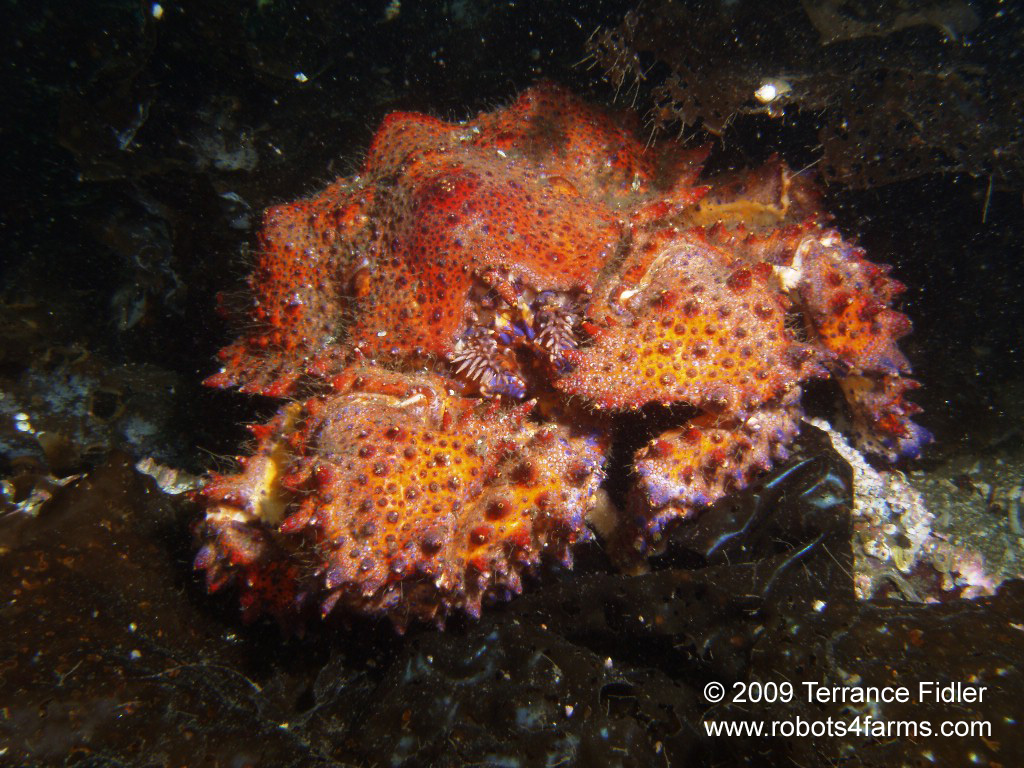
Our dive plan was to stay at 70 feet for 20 minutes, then do 50 feet for 20 minutes. After that, we'd see how much gas I had left as I was diving a single steel 100 and Teri and David were on doubles. 10 Mile Point lived up to its reputation as a great dive. The water was clear and blue, with visibility of about 30 feet or so. The wall was spectacular, covered in high-flow life and punctuated by many crevices. Teri found a huge hairy-spined crab in a crevice, much like the ones I saw in Port Hardy. There were some really great opalescent nudibranchs too. The wall below the parking area certainly had enough to see keep your occupied for a long dive!
David got too cold and decided to end the dive. Teri and I stayed, and decided to do the drift part of the dive. When we got out to the end of the point, the current picked up and off we went! It was a bit scary at first because it was pretty fast, but it didn't take long to get the feel for it. We cruised along over a bed of kelp bent over 90 degrees at about 60 feet for quite a few minutes. It felt a lot like flying, and indeed we looked at each other a few times and put our arms out like birds. Lots of fun! We ran out of anemones and headed up and over the rock wall as Scott had said. At that point we were very shallow and the current would disappear periodically due to sheltered areas. In one of these breaks, we came across a massive cloud of tiny shrimp. It was like a cloud of dust, so thick that you couldn't see the rock behind them. I'd never seen something like that before. We followed the shore up through the kelp beds and looked for the exit. We finally came across the pile of white shells, and came up. Getting out of the water was a bit tricky with all the rocks and wave action. Once on the rocks, we had to figure out how to get back to the road. Scott had said that there was access to the road from any point, but all we could see were people's houses and back yards. In the end, we cut through a back yard feeling kind of bad, but there didn't look to be any alternative. We were as quiet and polite as possible! Apparently the people living in the area were used to this.
We decided to go to another dive site because the current at 10 Mile was pretty strong. After a coffee and some lunch and a bit of driving, we arrived at Willis Point. That should be a Google Map link. It's hard to see where the dive site is, but it's there. There is a dirt parking area, and a long dirt path down through the woods to the water.
Willis Point turned out to be awesome, even better than 10 Mile because the visibility was better. The entry into the water was a bit hard over some jagged rocks, but it wasn't as bad as 10 Mile. There was a marker buoy not far off shore, and that's what we headed to. Not far past that was a really great wall. On the descent down there were quite a few moon jellyfish floating in the water. With the sun brightening the water, they looked great. It was fairly clear and blue, with visibility around 35 feet. There were a lot of big chunks of organic matter in the water, so it wasn't completely clear, but it was very nice. We came across a bathtub on the way down, which was pretty funny. Teri found an underwater compass which was a great bit of treasure. The wall was hard to describe. Suffice to say it was very interesting and I'd certainly go back. On the way up and in, it was the best part of the dive. The sun was streaming down, the kelp was waving in the water and it just felt generally tropical. Several spots had evidence of octopus, but we didn't find one.
There is some video footage of Willis Point here:
http://www.youtube.com/watch?v=PKxMNbZCzL0
All in all, diving in the Victoria area was great. I couldn't wait to go back!
Porteau Cove – 24/04/2010
Not the nicest day for a dive due to rain and wind, but I was itching to try out my new 400 weight thinsulate undergarment. It had been quite a saga to get the thing. I ordered the original back in October. However due to slow shipping, size problems and finally having it lost in the mail I gave up on that one after over 5 months of waiting and bought a DUI XM450. They just came out with tall sizing, and I fit it quite well.
Mihai and I decided on Porteau for the ease of the dive. The plan was also to do some skills, and I wanted to check my weighting with the new undergarment. We swam out to the yellow marker buoy on the right, which would put us near the artificial reef. We then planned to swim west to the Grant Hall wreck, then circle around the sailboat. We'd be not even getting to 60 feet for the duration of the dive, so we had plenty of no decompression time. We figured it would be a 45-50 minute dive. At the end, we'd swim in to shore and do skills at about 25 feet.
Visibility wasn't great but it wasn't horrible either; maybe 20 feet. We poked around on the artificial reef first, and I'm glad we did for we found an octopus in one of the crevices at 36 feet. One of its arms was waving out of the hole in the water which was pretty neat. It wasn't doing much, so we watched it for a few minutes then continued on. There were two huge ling cod, too. One was on the deck of the Grant Hall and it swam off leisurely into the darkness of one of the deck hatches.
While following the Grant Hall's hull down the starboard side, something weird happened near the stern at 45 feet. The was a distinct layer of very brown water from that point on down where the visibility was only a few feet. Above it, it was better. So we stayed out of that and went up to deck level and around that way. The remainder of the dive had nothing much of note other than a few decorator crabs. We headed along the bottom back towards shore, and stopped at 25 feet to do an S-drill then an SMB deployment and ascent drill. All of that went alright. There were rough edges that needed polishing but we did keep our position. The ascent drill was a bit slow too, but overall I was pleased.
The second dive was shorter, since I wanted to get back to the Shop to pick up cylinders for the next day. We entered at the boat ramp and explored around under the dock pilings. Again, not a tremendous amount of things that jumped out at me. There was a school of shiner perch that was neat. Also an old crab trap surrounded by hundreds of brittle stars. There were a bunch of dungeness crabs running around, too. The bottom under the dock was pretty sand and mostly featureless apart from the life that congregated around the pilings. We ended the dive after about 40 minutes, and an average depth of about 30 feet. We followed the rocks along shore back around to the boat ramp and that was interesting. When we got close to the exit, a distinct halocline happened. A layer of fresh water over top of the salt. Putting your head up through it resulted in a wavy surreal view.
The next time I go out to Porteau, I have to remember to find the firehose. If you swim to the first white marker buoy and descend there, not far to the west is a firehose that marks a path all the way to the sailboat. Apparently it's a very nice way to avoid a long surface swim!
Tuesday, April 20, 2010
Kelvin Grove and Copper Cove – 17-18/04/2010
I ended up diving two sites this weekend. Originally I had thought to do a crab dive on Saturday, but decided to put that off for another day.
Saturday found me teamed up with David Ryan, whom had invited me out that day. We planned to dive the Cut at Whytecliff Park, but Allan Wong texted us and advised that the visibility at Whytecliff was very poor. So we decided to dive Kelvin Grove instead.
It was quite a rainy Saturday which was unfortunate. We got to Kelvin Grove about noon, and there was another group of divers there packing up. We asked them how things were and they said it was not good. They didn't look happy! Still, they may have been too shallow, and we banked on the visibility being better deeper. I had my double cylinders set up and ready, but couldn't use them yet. I was waiting to schedule a check-out dive with Alan Johnson, but his drysuit was out for repair. That left me diving my single steel 100s. Not ideal from a gas-matching point of view, since David was on double 130s. My air consumption was a lot better now, so we planned the dive accordingly. I'd be the limiting factor, and I estimated that I could get a 40 minute dive averaging around 60 or 70 feet. Our plan was to do 20 minutes at 80 feet, then 20 minutes at 60 or so, turning at half my gas.
Hitting the water, things didn't look good. It was very very murky, with a lot of particulate matter in the water. We descended following the sandy bottom and could hardly see each other two feet away. I was leading, and we headed out to the right-hand rock wall. It took a bit of time to find it, or it could have just been an illusion since you couldn't seen anything. Once we descended past 50 feet, things cleared up thankfully.
I forgot how nice the wall at Kelvin was. There were a huge number of boot/chimney sponges, and most of them were very big. At least the size of a big dog. Many had something living inside, usually a fish or a crab. We came across a pretty big puget sound king crab, too. We checked all the cracks and crevices we could, but nothing of note was home. There was a particularly large ling cod that swam off into the gloom beneath us. It was 4 or 5 feet long.
Both dives were very dark due to the cloudy skies and layers of soupy water. Really they were much like night dives. There was little to no current which was pretty nice. We didn't have to expend much effort at all. I worked on my frog and back kicks, and felt good about them.
The next day Mihai and I dove Copper Cove. I had been meaning to explore it a bit, since the other two times I'd been there, I had just been helping Jason do his underwater map.
The day was a big change from Saturday: clear, sunny and warm. Too bad the visibility ended up being even worse! The tidal exchange that day was very large, and we were diving on the low tide side. Our first plan was to find the rocky reefs in the middle of the bay. We descended on the left hand point, and went north to 70 feet. Then we turned east and followed that depth to hopefully find the reefs. The problem was that the water was so murky. It took a long time to swim out down to 70 feet, as the sandy bottom was very shallow for a long ways. We spent a lot of time in soup, which wasn't so fun. After getting deeper, it did clear up, but the trip along the 70 foot contour was very dull. More sand and nothing to see. We did spot a big tanner crab on the way, but that was it. Finally we ran into the reef. It was kind of worrying, since it was so dark you could not see very far ahead. I was about to turn us around when we finally came across some rocks. The reef we found was fairly interesting, as well as big. There were a number of ledges and big boulders and crevices. We spent the rest of the dive exploring all that we could, since I figured we'd not find anything else interesting if we left. Mihai found a decorated warbonnet under a large boulder which was a cool find. There was also a boulder fully covered with zoanthids. It was like something out of Doctor Seuss. Large plumose anemones decorated everything. No octopus for us, though. There had been several folks who had told me that this reef could have lots of them. We swam back to shore following the bottom south. Again, it was a huge long stretch of sandy nothing. We did come across a prawn trap, which was the most exciting thing on the way, really. There were also a surprising amount of bottles everywhere. If you liked bottle collecting, you'd find a lot.
The saving grace to the sub-optimal dives was the nice day. It was like summer!
On the second dive, we had planned to check out the rocks to the east side of the bay. This fell through, though. We swam out a ways, then descended and were supposed to follow the bottom east until we hit the rocks. That didn't happen and we ended up on the same rock reef that we were on before. In hind-sight, we should have went out to the point on the left, descended and followed those rocks down to the wall that was supposed to be there. Too bad! I would have to remember that wall, since it would have been a lot more interesting than doing the same rock reef. Again, we had a long swim back to shore over sandy nothing. During the dive, the current made it like a little drift dive over the reef. That was kind of nice.
In the end, Copper Cove just wasn't that interesting!
Wednesday, April 14, 2010
Dodd Narrows, Gabriola Bluffs, Tyee Beach - Nanaimo – 10-11/04/2010
After a great weekend diving out of Port Hardy, it was another packed weekend of diving again. Terri Norfolk invited me along on this trip back around March, and I had heard a lot about Diver's Choice and Dodd Narrows. I couldn't wait to experience it first hand.
I've got a few above-water pictures of the trip here:
http://picasaweb.google.com/AntonNorth/ScubaDoddNarrowsApril2010#
There were a lot of travel logistics involved. We had 5 divers coming across from Vancouver, and the plan was to stay over night in Nanimo to do some shore diving on Sunday. Terri Norfolk, David Ryan, Allan Wong, Cedric Galere and me rounded out that crew. Allan was doing a tech dive with his buddies Greg and Richard, along with recreational dives after. On Saturday, we would be out with Ken from Diver's Choice, and Sunday would be just from shore. We had toyed with the idea of doing the wrecks near Nanaimo with Ken, but ultimately the poor visibility killed that idea.
Most of the logistics involved vehicles and splitting people and equipment up most logically. We ended up taking two cars, with Allan picking me and Cedric up, and Terri and Dave taking their own car. It was an early start on Saturday! The weather was awesome though, clear and sunny. We made the 8 o'clock ferry fine, and got over to Nanaimo in good order.
We basically hopped right onto the Diver's Choice boat when we got there. Ken met us with his newly built skiff which made getting gear from the parking lot to the boat easier. The skiff was a bit light and moved a lot, so you had to watch yourself especially when carrying heavy gear. Aaron was the fellow helping out Ken on the boat, and he was a good resource to help with stuff.
We met Richard and Greg, the two tech divers who would dive with Allan. Richard had participated in the recent SREU project in Indian Arm. We did a group picture, but Greg wasn't in it because he was changing at the time.
The first dive site was Gabriola Bluffs. Allan, Richard and Greg splashed first as they were on a longer tech dive with a decompression obligation planned. The bluff was a long, shear rock wall stretching up a good 200 feet or so. We did a live boat entry and descended. Cedric and I were diving together, and Terri and David made up the other team. Our original plan was to stay together, but that soon fell apart as we found out just how poor the visibility was that day. I'm sure it was no more than 10 or 15 feet at best, and it was very dark. Too bad! The dive plan was to spend 20 minutes at 90 feet, 20 at 70 feet, and 20 at 50 feet then do our controlled ascent to the surface. That all worked out pretty well, but the two dive teams got separated fairly quickly.
It's too bad the visibility was so bad on this dive, as I could really see the potential for this wall dive. There was a particularly huge rock overhang that would have been awesome to see in its entirety. I remember swimming along and noticed how dark it got all of a sudden. Looking up with my light illuminated the huge overhang in the gloom. The topography of the wall would have been great to see in larger detail, but oh well. In terms of life, it was pretty standard. A lot of giant white plumose anemones. There was one section of overhang that had a lot of them growing straight downward, and they had elongated to ridiculous lengths.
At the end of the dive, Cedric and I were quite far from the boat so I inflated my giant surface marker buoy for fun. David's mask broke on him after this dive which was a bad problem. It was a prescription mask, so any backup masks would mean fuzzy dives for him for the rest of the trip. He fixed it temporarily, but then it broke again on Sunday! We relaxed in the sun on the boat deck, had a nice lunch and then prepared for Dodd Narrows.
The Narrows could only be done safely on a slack tide, and even then there could be problems with boat traffic, especially log booms. Fortunately none of that happened today. The current in Dodd Narrows was what made it so special. It meant that it could be a very fast drift dive, and the amount of life in the channel was incredible. It was only about 200 feet wide, and 100 feet deep. There were several stories about people getting caught in upwellings and downwellings, in eddies on the surface and things like that. The general rule was to keep your regulator in your mouth until you got back on the boat. Cedric and I missed the Narrows unfortunately as we went the opposite direction. We missed part of the dive briefing and just assumed the current direction would be easily noticeable. We still had a nice dive, but ended up on the opposite side of the Narrows. Good thing I had my giant 6 foot surface marker buoy. You could see that big thing from miles away. I also found a working UK100 underwater light. Quite the treasure find. There were a lot of rock formations to swim around, and also a lot to look at. There were a few interesting nudibranchs and green anemones, but nothing big that jumps out in my mind. The other groups had a good dive too. The visibility was quite a bit better, but not stellar.
We got back into the harbour and unloaded everything. The plan was to stay at Ken's place, as he was set up to allow a lot of divers to stay. His house was big and comfy. There was room to sleep at least 10 or more. We met his little dog Niko, and his two goats. The goats were a bit of a surprise! That evening we unwound at the Longwood Pub. A good place with good beer and reasonable prices. We discussed the next day's plan, too.
We got up and left Ken's place at 8am and went for breakfast at the Granary. A pretty good home-style breakfast place. Our plan was to dive Tyee Beach at about 10, and we were meeting some other divers there, too. We found the place fairly easily and met Scott. He was a professional underwater photographer, and gave a pretty detailed description of Tyee Beach as a dive site. His website was http://www.8arm.com/.
The best place to dive on Tyee was to the right after you entered the water. Going to the left was shallow, full of eel grass and relatively dull according to Scott. To the right was a lot of rocks and a pretty long wall around 70 feet deep. There did seem to be sections deeper, too. The rock formations were like a layer cake, but with layers missing. This left hard rock plates separated by nothing, which made lots of crevices. The visibility wasn't the best, but it was better than at Gabriola Bluffs. We had maybe 20 feet of visibility I'd say.
On the first dive, Cedric and I teamed up again. We saw a few interesting nudibranchs and a lot of baby copper rockfish. Even though we looked in every crack we could, we didn't find much other than gobbies staring back with their black eyes. There was one neat hairy crab, though. We found you didn't want to keep going past where the wall ran out, as it turned into an uninteresting sandy slope.
There was another dive site very close by at Porpoise Beach, but we decided to stay where we were. The second dive was much like the first, but we spent more time on the wall itself, and shallower. There was a huge boot sponge all alone on one part of the wall. Coming up in the shallows there was a lot of waving kelp and algae. The light was pretty good, so it gave it a very bright and tropical look. Not tropical temperature-wise though. Terri sat this dive out due to being chilly. Cedric mentioned the same quite often too. I didn't feel too bad myself, but my hands were cold at the end of each dive I must admit.
Allan and David shot a bit of video on the dives, but with the visibility not great, most of it didn't turn out. I wasn't sure how many good pictures Scott got, I'd have to ask him later. He seemed pretty enthusiastic about getting out diving all over the place, trying to make a living taking pictures. I would think it was pretty tough to do that! He had a lot of good stories about some of his picture escapades. He'd even got pictures of the rare six-gill sharks in the BC waters.
If you have facebook access, Allan had two videos here:
http://www.facebook.com/#!/video/video.php?v=381272143045
http://www.facebook.com/#!/video/video.php?v=381188593045
Depending on his security settings, I'm not sure if you'll be able to view them or not. Don't bother trying to find me in the videos. Even though I'm tagged as being in them, I'm not!
We got back for the ferry, and had a few drinks out in the sun at the pub near the ferry terminal to kill some time. Out of the wind, it was an awesome warm day.
I have to get back diving around Nanaimo and try out Madrona Point, and do Dodd Narrows for real, too. Scott talked a lot about the dive sites around Victoria, which were supposed to be even better. Another place to check out soon!
Subscribe to:
Posts (Atom)