Tuesday, April 6, 2010

Port Hardy – Browning Pass Hideaway, Easter 2010

I had been looking forward to this trip for quite some time. A combination birthday present and reward for finishing the GUE Fundamentals course, along with some decompression time in the wilderness away from technology. I had been to the Hideaway in November, and seriously couldn't wait to go back. John deBoeck was an amazing guide to the dives of the area that Jaques Coustea said were his second favorite in the world.

Originally I had planned to dive double cylinders but that fell through with my injured fingers. Instead, I split my cylinders in half and was able to dive a single steel 130. The other I lent to my dive buddy Jason so that we'd have identical amounts of gas. 130's also allowed us to have some pretty long dives, and not be limited by our air consumption which was a real issue for me and such nice dives. I wanted to be limited by my no decompression limits or how cold I was, not by my gas!

The trip started on Friday very very early. I got up at 3:30am in order to make the meeting time of 5am at the shop. The night before I had brought over my gear and cylinders so that was taken care of. I got a bit nervous when I found out that 9 people were going in the van. I was very concerned that we'd not all fit! It turned out to be a non-issue, but it did lead to some stress that morning.

The van was cramped but it wasn't too bad. On board were Kyle, Genessa, Erika, Scott, Joe, Jason, Vince, Greg and me. It was a rainy and miserable morning when we made it to the ferry terminal. It was a good thing we took the early ferry as the winds were gusting a great deal and the waves were very high. The crossing to Nanaimo was rougher than I'd even seen it with the ferry rocking to and fro alarmingly. It was difficult to walk and to stand, and at one point a big wave caused a large amount of dishes to crash in the kitchen. The seas were so bad that the other ferries for that day were cancelled. That's why we were lucky to get on this one!

In Nanaimo there were numerous power lines down as well as trees. It was quite the storm, but we were very glad to have made it when we did.

The rest of the drive was relatively uneventful. Just a lot of rain and wind and difficult winding road driving. Kyle drove the van but wasn't able to change drivers because it was the Shop van. We did our best to keep him awake even though many of the folks slept on the trip. There was one close call while passing a slow vehicle. There turned out to be an oncoming car a lot closer than Kyle realized. We made it, but it was a bit scary! We did grill him for quite a while after that. Erika nearly had a heart attack.

We made it in to Port Hardy on time around 1pm, but John and his boat were not there. It turned out that he was stuck weathering out the high seas that were going on at that time. So, we had some lunch at the Quarterdeck Inn and just tried to unwind after the long drive. We had a good time getting to know each other, too. Allison and her son Nigel met us there, so our full complement was ready to go.

John made it through a break in the weather, and his previous guests unloaded and got underway. Then it was our turn. We got things loaded pretty quickly, but ended up waiting again since he had to go grocery shopping. I didn't complain because I wanted to eat while I was out there!

Around 5 or so we were on the boat, got fuel, picked up the skiff and the handy man Paul, and were finally on our way. Poor Allison was prone to seasickness, so she had to sit outside the whole trip in the rain. It was a rough ride. Not as rough as it was, but still bumpy and windy. John seemed kind of subdued, but I suspected it was due to the stress of the previous trip and probably lack of sleep.

We made it in to the Hideaway around 7 and the plan was to get in a dive then have dinner. We geared up quickly and headed out to Hideaway Island. However, there were gear issues that would plague us for the rest of the trip. Not me, but Kyle's neck seal was too small, Joe's glove leaked, Jason's gloves leaked, Kyle's computer crapped out, Erika had to replace an O-ring, Scott's drysuit dump valve stuck open amongst other things.

The dive site was not far away, and I hadn't dove the site before. Well, it turned out that I had after I went back and looked at my logs (so many dives close together really blur in my memory)! It was a fairly challenging due to the surging seas. Even at 15 to 20m depth, the water would push you forward then suck you back. In between surges, you could propel yourself where you needed to go, but you had to be pretty careful with your buoyancy otherwise you'd crash into the bottom or other things. I don't recall too much about this dive other than the surge, but it certainly was interesting. I'd never been in conditions like it before.

We had a hearty dinner made by the cook Debbie, and turned in for the evening. The plan was to get up very early and try to make up some dive time. Unfortunately, due to compressor problems and the gear issues, we'd only get four dives done that day. We started out in the Nursery where we had more fun with surge. It wasn't too far from the entrance to Clam Cove and the Hideaway. There were a lot of interesting rock formations here, covered with kelp fronds. There was something of a wall when we first descended, but we had to stay on the inside of the island due to current so we didn't have a chance to explore that on the outside. The white sand was piled up very steeply next to this wall so we didn't spend much time deep. The rest of the dive was spent around 10m puttering around the rocks and kelp. The sun was streaming down from above so that made it very bright and pretty.

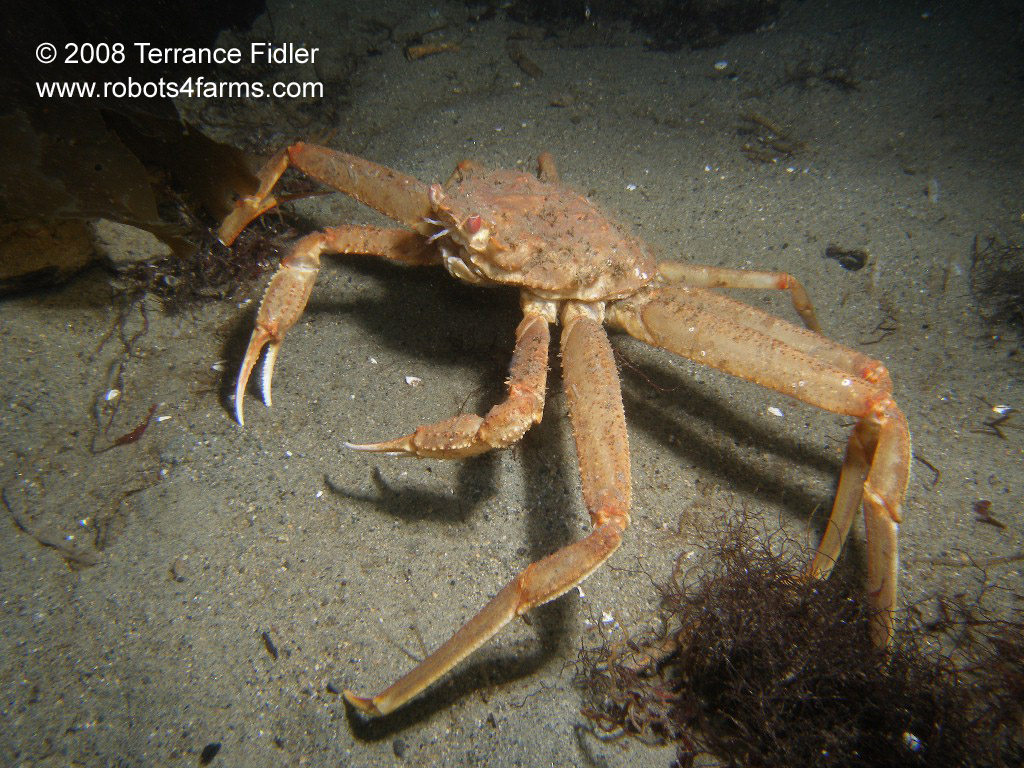
The Rock of Life was next and Jason was particularly awed by it. There was just so much life to see. We saw two opalescent nudibranchs on that dive, along with a lot of basket stars and a huge puget sound king crab who had two big brown box crabs as neighbours. After lunch, Eagle Rock was next. Vince ended up somehow going so far that he ended up at the Snowfall dive site. He also appeared to get stuck in the thick kelp, and Kyle went in to rescue him. In reality, he was ok, but better safe than sorry. Rounding off the day was the famous Browning Wall dive. It was awesome, but very challenging with all the surge and current. I found you'd get pushed into the wall very easily and it was difficult to push away without harming any of the life encrusting it. A good back kick was very useful. Unfortunately I didn't have a good one yet! But the practice was nice. When I did need to push off, I'd use one finger and carefully pick a small exposed bit of rock.

With the issues and weather during the day, we decided to call it a day, get some sleep and get up early again. I took the opportunity to have a nice hot shower and a shave. Erika logged all the species she saw every dive for the Reef project. She was up late every night doing that because there was just so much to see. Paul the handy man battled with toilets and plumbing all day. He also did a great roast on the barbecue. The Easter Bunny came that evening, with chocolate eggs waiting inside for people, and eggs hidden outside as well. With the blowing wind that night, I was afraid he'd have some problems, but the eggs stayed in place.

The next morning found us on Browning Wall again, and it was equally as challenging as the previous day. There was what looked to be a puget sound king crab in a crack, but it turned out to be a hairy-spined crab. Its claws looked very similar, but the crack was too flat for the big tank-like puget sound king crab. We also saw a cool grunt sculpin. Three of us squeezed in a short dive after that before lunch inside Hideaway Island. It was a very nice sheltered bay, with a flat sandy bottom and a small rock wall. We saw a huge red irish lord, a big orange-peel nudibranch, and a smoothhead sculpin. The sculpin was lying on top of a pile of black muscle shells, and it was so well camouflaged that at first I could only see a disembodied fish head. Upon surfacing, Scott spotted an otter/mink looking thing scampering on the rocks above us, and looking curious. John figured it was a mink when we asked about it.

After that, we did Seven Tree Island. As we left, Vince forgot his hood so we had a delay while we went back. A good reminder to always keep one's gear on the boat! On that dive, everyone but Erika and Joe missed the giant pacific octopus hiding under the kelp at the beginning of the dive. I lost a double-ended bolt snap, but Genessa found it shining on the sand. The end of that dive was like being in the tropics with a vast stretch of white sand.

We got in another fast dive inside Hideaway Island after that. John got his anchor snagged, so Vince went down to free it. When he started to take too long, I went in to assist too. We got the anchor back up and it was pretty fun. Later I'd count this as a dive, because according to Paul, in the WRSTC (World Recreational Scuba Training Council) a dive with a purpose doesn't have to have any set length. We did the Rock of Life again to round out the, which made Jason happy. We skipped the night dive because it was just a bit too late and not a lot of folks were interested. It didn't seem worth it to bust our backs getting fills done and popping out for such a short time. Showering and sleeping turned out to be a better choice.

On the final day, we got up early yet again to do Browning Wall one last time before packing up. This time my back kick was a lot better and I never pushed off the wall once. However, there were some problems on the dive. Scott lost his mask, and Nigel went down too quickly to get it. This resulted in a mask squeeze and him getting a pretty bad bloody nose. Scott also lost his camera and went down with Erika to find it. Unfortunately they got separated and Scott went a lot deeper than he should have. Erika had found the camera almost immediately. A good lesson in keeping close to your buddy. There was also an issue in that he came close to exceeding the maximum operating depth of the nitrox he was breathing. However, everything ended alright thankfully and some lessons were learned.

It was a fabulous sunny day and we got packed up and underway without much incident. On many of the dives, the bull kelp provided convenient ascent and descent reference points. Also, old growth kelp with its short strong stalk helped us keep position on shallow safety stops in strong wave action near rocks. It was funny that there were no jelly fish at all, though. I think John said that they were between seasons. I also remember seeing a smooth velvet snail just after seeing it in the marine life book. It was pretty lucky, otherwise I would have had no idea what it was.

Once back on the road, there were no other problems. The drive back was a bit better than the drive up, but there were still some bad rainy spots and wind. We made the 6 o'clock ferry, and everyone was back in Vancouver by 8pm! I couldn't wait to go back...

Here is a list of the species I remember seeing:

old growth kelp

bull kelp

blue branching seaweed

cloud sponge

glove sponge

giant plumose anemone

white-spotted rose anemone

green surf anemone

strawberry anemone

orange zoanthid

tan cup coral

red soft coral

orange sea pen

pink gorgonian

whie hydroid

giant pacific chiton

smooth pink scallop

giant rock scallop

leafy hornmouth

smooth velvet snail

noble sea lemon

monterey sea lemon

white nudibranch

heath's dorid

yellow-rimmed nudibranch

white-rimmed nudibranch

Hudson's dorid

Cooper's dorid

diamondback nudibranch

orange-peel nudibranch

frosted nudibranch

opalescent nudibranch

opalescent squid

graceful kelp crab

helmet crab

graceful decorator crab

longhorn decorator crab

hairy-spined crab

rhinoceros crab

heart crab

puget sound king crab

brown box crab

giant acorn barnacle

basket star

red sea cucumber

giant sea cucumber

broadbase tunicate

pacific sea peach

blackeye goby

mosshead warbonnet

decorated warbonnet

china rockfish

blue rockfish

black rockfish

kelp greenling

painted greenling

smoothhead sculpin

red irish lord

grunt sculpin

Next weekend would be Dodd Narrows, a very fast and extreme drift dive! I should have some photos and video from the folks who had underwater cameras soon too. You can check here as I continue to upload that. Right now, it's just a few pictures from my own camera.

http://picasaweb.google.com/AntonNorth/ScubaPortHardyEaster2010#

Monday, March 29, 2010

Copper Cove and Kelvin Grove 27-28/03/2010

With the GUE Fundamentals done, the Instructor Dan Mackay told us to go out and do some fun diving. Copper Cove wasn't necessarily “fun” because it was a working dive to map the bottom, but Klevin Grove was a fun dive for sure.

Jason had been working on his PADI Dive Master course, and we had started the underwater mapping project a few weeks ago. Unfortunately, we weren't able to get the deep 24m depth contour done on the previous dives. So, with Port Hardy taking up next weekend, this was the only time to get it finished.

We got out to Copper Cove very early. There was a lot of ferry traffic that was stirring up the bottom, so it wasn't very easy to see much during the dive. It was basically like a night dive it was so dark. Jason's light got very dim on him, so it was tough to write down the data as we measured things out. I didn't have a problem because I wasn't writing anything, just measuring depth and distance. It was a real working dive, and we used up our air pretty quickly. There was not a lot that I remember seeing, but there were some nice anemones and sea pens, along with a buffalo sculpin camouflaged against the rocks. Swimming back along the bottom to shore was pretty dull too. The bottom of Copper Cove is pretty sandy and plain. I think I remember seeing a few crabs along the way.

At the end of the dive, the water near shore was full of debris and junk. It was pretty yucky. We heard later that the visibility was so bad that they cancelled the Open Water course that was supposed to be training in the ocean at Whytecliff. I took the opportunity to work on my backkick at the surface though. I think I got moving backwards a bit which was encouraging. We opted out of a second dive since Jason's light was basically dead. I think we should have stuck it out in hindsight since the day turned very sunny and bright, but oh well.

The next day, I went back to Kelvin Grove with another DIR diver David Ryan. He would be coming along to Dodd Narrows with me on April 10, so it was a good opportunity to have a fun dive and to get to know each other. We had met at Kelvin Grove actually.

I got a lot of sleep the night before, but I had woken up a few times to hear very heavy rain. I was a bit worried that we'd be in for a wet day, but it turned out not too bad. It did rain briefly in the afternoon, but that was it. There was a group of 5 other divers there when we arrived. They were doing a single dive, then were off for a tour of the hyperbaric chamber that Vancouver General Hospital. They invited us along, but there wouldn't be time for us to finish our planned two dives and get back to town. I'd have to remember to check back on that tour sometime, it sounded interesting.

On our first dive, David led. Our plan was to do 20 minutes at 30m, then 20 minutes at 24m, but we ended up between 24 and 15m mostly for that. Then the last 20 minutes would be following the bottom back up to the surface. Kelvin Grove has a very nice wall to the right. I had forgotten how nice it was. There were interesting overhangs of rock, big cracks and crevices, and lots of things to see.

The beginning of the dive wasn't so great. We could hardly see a thing there was so much crap in the water. I lost sight of David if he got 5 feet away. But, once we got down past 15m, it was nice. Dark, but nice. It was basically like a night dive. It was also a bit dicey in that David's primary light didn't switch on properly at the beginning of the dive. We did get it going, but that would have been bad.

During the dive itself, there was a lot to see. The cloud sponges and boot sponges were really neat. David found an octopus deep within a crevice. There were quite a few big ling cods, and still a lot of long cod egg masses as well. There were nudibranchs everywhere, and I'd never seen a chiton standing on its end before. Normally they were glued to the rock. At the end of the dive, David went through a valve drill, and I practiced my backkick some more.

We spent an hour on the surface eating some lunch and talking about dive locations. Cozumel, Mexico was one place David said was good and cheap.

I led the next dive, and the plan was to stay shallower. We'd do 20 minutes at 24m then 20 minutes at 18m with a gradual ascent to the surface after that. Again there was bad visibility until below 15m, but it was a pleasant dive after that. I saw some kind of pink eel-like thing in a crevice which I couldn't identify. I'm not sure if it was just a fish of some kind, or a juvenile of something. I'd have to look it up later. Again at the end of the dive I did some backfinning practice, and I think it went ok.

We packed up and got rained on briefly, but it didn't last. The creek beside the dive site gave a handy location to rinse some of our gear too.

I had forgotten how nice Kelvin Grove was to dive. I'm glad I went again!

Friday, March 26, 2010

GUE Fundamentals 21-24/03/2010

I had been looking forward to this course for some time. Quite a whirl-wind four days of training, which I ended up passing.

I`m not sure if I shall try to do a write up of everything that occurred. If I do, it might take a while!

Monday, March 15, 2010

Indian Arm Boat Adventure 14/03/2010

Weather stopped the planned dive of the HMCS Saskatchewan once again. We assembled early at Shaun's boat, but the gale and hurricane warnings north of Nanaimo were too worrying. We ended up going with our backup plan of Indian Arm. No one but me had dove there, so it was a good compromise. We headed for Crocker Island and the fishbowl that I had done before because I figured it was the best dive I knew up there.

It was a long boat ride from False Creek. Aboard were me, Patrick, Jason, Vince and Shaun. The weather was grey, but the sun came out periodically so it was pretty nice. We had a nice time chatting on the way up. At the fishbowl on the southern tip of Crocker Island, things didn't look so good! There was a lot of brown murky water in sharp contrast to the crystal clear visibility I had before. Jason, Vince and I decided to dive first and check it out. The brown layer was very short-lived, and the water cleared up nicely below 10 or 20 feet. This made for a very nice dive. We checked out the fishbowl, then went around the rock wall on the east side. The drop-off was impressive. Not much to see on the wall again, but there was an interesting colony of decorator crabs all in one spot. The rocks themselves were the most interesting. Very nice formations. At the end of the dive we messed around in a flatter area with boulders and anemones.

Shaun and Patrick dove next, as someone needed to stay on the boat. The sun came out again and illuminated the snow and tree covered peaks all around us. It was very pretty. At the end, everyone was impressed by the fishbowl. Some scenery pictures of the trip are here:

http://picasaweb.google.com/AntonNorth/ScubaIndianArmBoatTripScemeryMar2010#

We decided to try Racoon Island next, but not the west wall that I did before. We explored the north point instead. Vince and Shaun (Shaun was worried about the boat) decided to sit the dive out, and it was me and Jason and Patrick. It wasn't a bad dive. It was quite shallow, maybe 10-15 meters, and the brown water made visibility a bit poor. We also spent too much time in a large sandy area with no topography. There were a lot of rocky reefs, so it was certainly an interesting place if you stuck to those. There was also a spot with a lot of bottles scattered around. I wondered if someone's groceries had fallen over board. We also checked out a drop off that sloped off rapidly to nothing. It seemed like those were common in Indian Arm.

Back on the boat, it was raining so we packed up quickly and got under way. Again, a long ride back to False Creek, but we talked more and had a good time.

At the dock, I slipped and hurt my hand a bit. Completely an accident, but I figured I would be out of diving for a few days. That's why this isn't very long, I was typing with one hand!

Oh, and I did do four dives on the Saturday before this. I helped Jason out mapping a place called Copper Cove for his Dive Master course. Patrick was along too. Copper Cove was nice. Just had to make sure to stay around 16 to 20 meters, and keep around the point on the left. The middle of the bay is flat uninteresting sand! We spent a lot of time there though mapping the depths. It was one of the hardest working dives I'd been on as you had to count kick cycles for 10 meters, and do 20 of those, so 200 meters of swimming at a time. We ended up doing 3 depths, so that was 600 meters. I much preferred regular take-your-time diving!

Tuesday, March 9, 2010

Strathcona (White Rock) 08/03/2010

The end to three days straight of diving, dive number 88! I was closing in on 100. My plan was to have enough dives so that I'd hit 100 on my trip to Port Hardy on April 1st. I was thinking I might have to stop some of my diving, otherwise I'd have too many! I had at least 6 more planned, along with the open water dives for my GUE Fundamentals training course. I suppose I could not count the training dives in a pinch.

Anyway, I had tried to go on a night dive with Alan and Evan a few weeks ago. The plan was to go to Strathcona (White Rock) near Deep Cove to pick up some dungeness crabs. Unfortunately, that dive was cancelled when Alan smashed his head into the truck tail gate by accident. So, we planned it again, and it worked out. Evan couldn't make it, though.

It was an awesome night for a dive. Completely clear sky, and a spectacular view of Orion's Belt. It was cold though. I had to wear my toque and gloves while we were getting ready. Strathcona, also known as White Rock, was not to be confused with White Rock the community south of Vancouver. Strathcona was the road name, and White Rock was the small island just off shore. At least I think it was! There were about 3 or 4 parking spaces available. No bathrooms that I could see though, and a lot of residential houses around. Gearing up on the asphalt was nice and clean, but there were no tables to help you get into your gear. Alan had double 130s, and I was using my single 130. Pretty soon I'd be in double 130s as well, but not yet.

The tide was out, so the water level was very low. We joked that we were just going to wade out to catch the crabs. There were a lot of private docks nearby, so you really needed to pay attention where you might come up. You did not want to come up under someone's boat or dock. Still, it was pretty easy to steer clear of them if you used your compass, and paid attention to the underwater signs. It would get brown and gross when you were under a dock apparently. The island was south east of the entry point, and if you swam to it and headed around it to the left, you'd come across a nice wall. You would not want to go around to the right of the island, because that was extremely shallow and dull. Also, watching for boats was a good thing, although at night boat traffic was non-existent.

For our dive, we stayed between shore and the island. At low tide, the bottom was only 4 meters deep. But the number of crabs was astounding! I'd never seen so many, and big ones, too. It only took 8 minutes to fill Alan's crab bag. By the time he got one in the bag, there was another big one right there. There was quite the halocline going, too, which made the whole experience wavy and surreal. There must have been freshwater runoff nearby. At one point, Alan opened the crab bag, and one of the ones inside made a break for it and literally jumped right out! I had to grab the first one while Alan wrangled the escapee back in, then got the next one in too. I almost laughed underwater several times. Once the bag was full, we messed around chasing a few of the other crabs around. We also spotted some kind of centipede-looking thing on a blade of eelgrass. I guessed it might be some kind of isopod, but I'd need to check it out later. With crabbing done so fast, we decided to practice some skills. We went through a full gas-sharing drill, Alan did a valve drill, I tried to reach my own cylinder valve (with limited success, but got close), and I tried some more backfinning. The backfinning didn't go very well, but I was still confident that with the upcoming training that I'd learn it. Alan thought the same. It just came down to practice, and not doing it at night, in the dark!

So, we packed up the seafood haul, and called it a successful evening. No one had an accident, either!

Buntzen Lake 07/03/2010

My first fresh-water dive! I had wanted to do a fresh-water dive for a long time, and had heard about Buntzen Lake from a few people. They filmed a few episodes of the X-Files there, and a couple of movies. Buntzen Lake was a man-made lake used to feed a power generating station. I think the station was just used for an emergency backup now though.

Buntzen Lake was in Belcarra Regional Park, and was a very nice area. Very much the BC wilderness, and was very relaxing. The tree-lined drive up to the park, and the tree-covered slopes rising up from the lake waters were very nice.

When we arrived, we had to drive down to the boat launch area and drop off our gear. There was no parking near the beach, but there certainly was a lot of parking available. Once we got that sorted, we picked a picnic table close to the docks and checked out the water. The bathrooms were located as far away as you could get from us, unfortunately. There were two sets, but the closer ones were closed for the winter season. The open set was at the other end of the beach, near the enclosed dog run. An entire section of the beach was fenced off for dogs to use. That was pretty nice for dog owners, that's for sure. We were accompanied by some of Mihai's friends, and they had two dogs so that worked well. A small note, dogs were not allowed on the other areas of the beach, and a park official actually visited us and warned us of that fact. Just something to keep in mind!

The waters of Buntzen Lake were very dark and brown. It reminded me a lot of the lake waters in Ontario, brown with tannins. Signs were posted everywhere warning about a steep drop off. They weren't kidding! A few feet into the water, and it appeared to drop off to nothing.

We geared up and adjusted our weighting removing about 4-5 pounds to account for the lower density of fresh water. Our plan was to run through some skills on the first part of the dive, then explore down to about 30 meters. The water was about 5 degrees Celcius and it felt pretty cold on the face! Dropping down to about 10 meters, we did our skills. Everything went pretty well, but during my mask removal I breathed in too much and ended up ascending quite far. I got things sorted, and re-did it and it went better. Mihai had some problems with his horizontal trim, and was kicking the bottom a lot. But other than that, we got things done ok.

After that, we descended further down to 30 meters. The steep drop off ended about 25 meters or so and it gradually descended fairly flat from there. It was so dark down at 30 meters that it was like a night dive. There wasn't much to see, just an endless muddy bottom punctuated every so often by discarded beer cans. We did find three small bottom dwelling fish that looked a lot like small sculpins. I salvaged a lot of old stuff on all the dives, too. I found two pairs of sunglasses, a dog toy, a stubby beer bottle, two golf balls, and a kids scuba mask. Nothing valuable, but there must be a lot that got lost in such a popular lake! On the way up, we also came across the dead trees that people had told us about. They were very spooky looking in the dim, brown waters. Very skeletal like. One had been decorated by divers with bottles, cans, scuba masks and other junk. It was like a junk Christmas tree. There were also at least three sets of kayak paddles shoved blade up in the mud at various locations.

Surfacing, we found that the rain had really started. Poor Christina was pretty wet. Our surface interval was damp and cold, alas. So much for the nice weather! I gave the recovered dog toy to their dog friends.

On the second dive, we started at the boat dock and then swam to the east along the drop off at about 15 meters. This seemed to be where the most interesting stuff was, most notably the dead trees. Near the dock was one big dead tree that was covered with fishing line and lures from people getting snagged. I didn't recover any of these, though, and left them alone. After heading a ways east parallel to the beach, all the interesting stuff disappeared. All that was left was a slope of sand and mud. We turned back then, and found some of the dead trees to look at. There was one section of the slope that was covered in red rust-like deposits. That was about as interesting as it got! In one of the trees, we found some rainbow trout minnows. There were quite a few of them, all bunched up in the cracks in the wood. They were maybe 2 inches long, and glistened and gleamed quite nicely. Finally, we ascended back to the shallow ledge. There were a lot of underwater grasses there.

Buntzen Lake wasn't the most exciting dive location ever, but it was alright. The lack of current would make it a good place to try out new gear. Still, it's a long way to travel, and there are certainly better, more interesting dive sites in the ocean which outweighs the benefits of not having to rinse your dive gear!

Porteau Cove 06/03/2010

This was the start of a three day stretch of diving. I had heard from Landon that he was taking a small class out and I decided to tag along. It worked out even better, since they actually went to Porteau Cove instead of Whytecliff, and Genessa and Shaun were doing an advanced open water course. So I tagged along with them and their group for two decent dives, rather than just hovering watching people do skills! Oh and even more good news, the outdoor shower was on again after being off for the winter. One other reason making diving at Porteau Cove extremely convenient.

It started out being not the best morning for a dive. There was a significant amount of wave action, and it was cold and windy. It was high tide, so the surface swim was not only rough, but longer too. One person got so sea-sick they had to cancel their dive just from the swim. The class had 6 people in it. I stuck with the group that Shaun was doing. There wasn't much of a current so the swim, while rough, wasn't hard. We all made it out to the buoy and descended. The plan was to do some buoyancy skills, then head out for a short dive. I just hung around the group mostly watching. I fiddled a bit with my buoyancy, but didn't practice many skills myself other than to act as a reference and good role model. I tried to stay as horizontal and trim as possible, all the time. Genessa said later that I did a good job. Everyone in the class was dressed the same, all in black. I was the only one who stood out with the red accents on my drysuit, and powerful light. The visibility wasn't very good, so it was a good thing that I had my light along. I'm sure it helped people keep track of where the main group was. There was of course a lot of silting, but that's to be expected. All the divers came from warm-water backgrounds and were still learning drysuit and cold water diving. A lot of fins were hitting the bottom!

There wasn't much to see because of the poor visibility, and the fact that we weren't moving around much. But there were a few nudibranchs and ling cod, as usual.

The day really brightened up, and the waves petered out so the second dive was just great. It was almost like being out in summer. On the swim out for the second dive, I had my first encounter with a real panicked diver. Landon was handling it, but I went over to assist in calming them down just in case. One of his students had problems with doing a mask clearing skill, and tried to bolt to the surface. Landon brought him up safely, but it was quite an experience to see something that I only practiced for in the Rescue Diver course.

The second dive was around the Grant Hall, and it was nice. Shorter, but nice. I saw a nice sized buffalo sculpin camouflaged on the hull, and a really big ling cod. We didn't go by the octopus den, which was too bad. But we did swim around the pipe reef which was fun. Shaun dropped his underwater signaling shaker, which I saw and picked up and gave back to him later. So I helped out! I didn't feel like keeping an underwater shaker thing, anyway, hah.

Hanging out after the dive, Shaun mentioned he and his boat were free for diving the coming weekend. So plans were set in motion to see if that could be made a reality. Tentatively, we discussed going to Nanaimo and diving the HMCS Saskatechewan. I hope it would work out!

Monday, March 1, 2010

Nakaya Wreck Dive 02/28/2010

Ever since diving the VT-100, I wanted to dive the Nakaya, the same Yard Mine Sweeper class of vessel but sunk at Porteau Cove marine park. It was designated YMS-420 before being sold to Harbour Ferries in 1970 and renamed Harbour Queen No. 1, then renamed Nakaya in 1980, and finally sunk in 1992.

Firstly, to find the Nakaya was dead easy. A lot easier than what my research uncovered. The material I found was fairly vague, and had compass bearings and no travel times.

Directions to the Nakaya, starting from the stairs down to the water:

Swim to the very last and very far white surface buoy on the extreme right (closest to shore).

It is a long swim, about 320m using the ruler tool in Google Earth.

Descend along the line from the buoy all the way to the bottom (depth about 25m).

If you face a compass bearing of 30 degrees, and then turn 90 degrees to your left and start swimming, you'll run right into the Nakaya.

The Nakaya is not far from the line. Maybe 20 or 30 feet. If you miss it for some reason, return to the line and try again.

I had been planning this dive for a week or two, with several divers included but in the end only Jason could make it. To be fair, it was the Olympic closing ceremony day, and the big Canada vs. USA gold medal hockey game was on. It was an awesome sunny day for a dive, and I was able to participate in the celebrations after getting back, so I think I got the best of both worlds.

Gearing up for the dive was not as pleasant, since it was drizzling at the time. This cleared up though and it got very sunny. We didn't have too much trouble getting into the park, but there were traffic cones set up to prevent you turning left due to the Olympics. Once in the water, we started the long swim out. It was right around low tide, and the water was pretty slack so there was not much current. Once we got to the white buoy, we did what I thought needed to be done to find the wreck. We first swam on the surface along 30 degrees looking down trying to see the removed marker buoy. We had no luck doing this, so returned to the white buoy. We decided to descend there, and head along 30 degrees on the bottom to try and run into the bottom of the supposed line. We did that, but swam a long way without finding anything. Every minute I thought I saw something in the gloom, but it was always just my eyes playing tricks on me.

Eventually the bottom started turning into sharp rocks and looked like it was going up to shore. So I turned us around and we headed back along the bottom at 30m. This was the other way of finding the Nakaya, since we should in theory run right into it if we stayed near its depth. Luckily, it worked, and the bow of the ship loomed out of the gloom. It was tall! The ship was 40m long, so it was a big one. The bow was in great shape, not crumbling or anything. As we followed the hull along the starboard side, it started to show more signs of deterioration. There were holes in the hull near the deck level, and they gave it the appearance of a railing on a spooky ghost ship. On the other side, schools of shiner perch darted around in our lights. Half way down the hull, I looked to the east and saw a line. I figured that was the “missing” line that we had been looking for. Little did I know it was the same line we came down on! We had descended right beside the wreck, only to swim off and totally missed it until we came back.

We checked out the stern section which was really crumbling, and headed up to the deck level for a bit. There was no deck left really, just big holes into the hold. There was a lot of sediment accumulated in there too. Not a lot of life down in the holds. But the hull and the remnants of the deck had quite a bit. There were a few really big ling cod guarding their egg masses. There was also a lot of decorator crabs and coonstripe shrimps, along with a hairy crab and some squat lobsters. The highlight of the dives was a giant dendronotid, a red flabellina and a leopard dorid. We looked and looked for octopus, but there were none.

The second dive was much the same as the first, but we were able to spend more time on the wreck now that we knew how to find it. It really was a lot of fun to explore, and was a lot more interesting than the VT-100. This is the kind of dive where Nitrox comes in very handy to extend your bottom time, since it is quite deep. I was also very pleased that my air consumption rate had gotten a lot better too. It had been pretty high for a long time, and it was nice to see it improving. Less air consumption equals longer dives, something that I'm all for!

Friday, February 26, 2010

Whytecliff Night Dive 25/02/2010

After aborting a Thursday evening night dive last week due to the Olympics, I figured it was high time to get out for one. Also, it was getting closer to my next set of dive training, and trying to get in as much diving as possible was a good thing.

The original location was supposed to be Porteau Cove. Mihai had not dove that at night yet, so we decided on that. Unfortunately, Olympic traffic changes made it so that we thought the park was closed. We drove all that way, only to give up and go to Whytecliff. The traffic cones appeared to be blocking the road completely. Later checking showed that it was supposed to be open. Blah. Checking before we left would have been a good idea, but who knew. At least I knew that my planned Nakaya dive for this coming Sunday would be a go. We missed the turn off to Whytecliff as well, and had to turn around and come back. It was just not going well!

The night was quite nice at Whytecliff. It was partly cloudy and the half-moon was out so it was pretty bright. It was also not raining and the parking lot was nice and dry. Gearing up took a bit longer because Mihai was checking out the fit on some new fins. The night was wearing on! I knew it was going to be a late one.

The tide was extremely low, which was a bit problematic. The water level was way down past the sandy part of the beach and we had to cross the exposed slippery rocks. Also, visibility was extremely poor. There was a tonne of particulate matter in the water. I figure you could at best see 10 feet. Finally, even though we should have been diving on slack tide, there was some kind of crazy currents going on.

We decided to head along the right hand rock wall out to the day marker because visibility was so bad. Keeping track of the rock wall in the dark and the poor conditions was a big challenge. The dive itself wasn't too bad. We made it out to the day marker and poked around in the rocks and crevices. The highlight was a large rhinoceros/golfball crab. There were a lot of young ling cod and kelp greenlings too. I ended up turning the dive early because I was worried about the current. On the way back, my primary light failed on me and I had to deploy my backup light. It was a nice bit of practice, but I was pretty annoyed. In the end, I believe it was just the battery. I had not charged it since the boat dive on Sunday, so it had been on at least 2 or 3 hours which was getting close to its maximum burn time.

After the light failed, I lost track of the rock wall and we ended up out on the sandy bottom with no reference. I had a compass heading and was following that, but Mihai thought it was a different direction and we had a bit of a discussion underwater on who was right. I was the dive leader, and all I could do was trust my compass, so I kept us heading my way. We did run into the rock wall, so at least I wasn't completely off. We were getting very shallow again and I lost control of my buoyancy in the last 2 meters and ended up surfacing. At that point, I just called the dive. Too many problems, and I was not feeling very comfortable any longer. It was still a 40 minute dive, so that was good. However, my air consumption rate turned out to be better than normal, so that was a good thing.

I tried out my light on shore and it came on but went out again twice. That's when I started suspecting the battery. Another small problem was the smell. Our dive gear smelled awful. There was certainly something in the water! Rinsing it down in the tub didn't help much either. It will fade, but just another niggling issue to a whole slew of problems.

Monday, February 22, 2010

Howe Sound and Indian Arm Boat Dives 20/02/2010 and 21/02/2010

A big weekend of great diving!

Saturday was a trip planned through IDC with the Sea Dragon. Adrian had asked if I'd be in to some diving this weekend, and we decided on a boat dive. Jason ended up signing up too, so we ended up as a trio. It worked out pretty well as we were well matched for air consumption and bottom time.

The ride out was a bit cramped. I had originally arranged to hitch a ride with Adrian, but two other divers needed a ride too, and he agreed to take them as well. A nice gesture! With all the gear though we fit just barely. I had brought along two cylinders as I was diving Nitrox, so that added quite a bit. Anyway, we made it and car pooling more is always better! And helpful. I hitched a lift back home with Jason though so it ended up being more comfortable.

It was completely clear and sunny, but nippy. We got underway after 9, so it was a late start. Kevin and Jan made Jason and I very happy by taking us to some brand new (for us) dive sites. We started on Christie Islet, and for the second dive did Pam Rocks.

Christie Islet is here:

http://maps.google.ca/maps?ie=UTF8&hl=en&hq=&hnear=Vancouver,+Greater+Vancouver+Regional+District,+British+Columbia&ll=49.499573,-123.301953&spn=0.003881,0.008433&t=h&z=17

It's not much to look at! We dove around the south west side of it. It was a nice dive, but less life than I would have thought to see. The bottom was a mixed bag of large rocks and ledges, so it was interesting terrain. There was a mooring line that we could descend on, which was also nice. I found out later that Shay the boat operator I'd be with the following day had placed that mooring line there. There were some really big nudibranchs and anemones, as well as some scallops but not much else that really jumped out in my mind. Jason was leading the dive, and we did a big circle back to the mooring line. When we got back, we still had gas left, so we headed back out for a bit. We did come across a big mass of ling cod eggs. It looked like white Styrofoam beads. On the way back, I lost track of our orientation, and paused to wait for Jason to head us back. But he ended up sitting there waiting too! I had to get his attention and get us moving again, but it was no big deal. The second dive group had come down much later than us, so we were starting our ascent when they came down. Boy did it look like a sand storm because of all the sediment stirred up! But there were some new divers in the group, and proper propulsion and fin control take time to get the hang of. On the ascent, Adrian and I were at a shallower depth and I could see Jason at the bottom of the line looking around for us. It took a bit of signalling with my light to get him to finally look up and see us. It's funny how we forget to look in three dimensions. Adrian tried out his spare air canister on the way up, and on our safety stop I practised deploying my surface marker buoy. It didn't go too badly, but could have been better. I had a hard time clipping the double ended bolt snap back onto the spool to secure the line. In the end, I couldn't do it. I'm glad I didn't drop the spool, otherwise I'd be hauling up a lot of line!

From Christie Islet, Pam Rocks was very close, just a bit to the south. I had heard a lot about diving with seals there, since there were usually a lot of them and they were always curious. The sun was shining, and we sat on the bow of the boat for a while soaking up the sun. I ended up almost getting a sunburn! So much for winter diving! We did have an equipment failure though. Adrian's fin strap broke on him, but a replacement was found. A very good example of why having spares around is a good thing! I made a note to add a strap of that type to my save a dive kit. Also, I had to remember to bring my oxygen analyzer on every dive, because sure enough I left it at home and someone needed one on this dive too!

Pam Rocks is here:

http://maps.google.ca/maps?ie=UTF8&hl=en&hq=&hnear=Vancouver,+Greater+Vancouver+Regional+District,+British+Columbia&ll=49.487678,-123.299539&spn=0.003882,0.008433&t=h&z=17

We ended up diving around the south west side of it. Unfortunately I didn't realize that we could have and should have went south east. There were a lot of interesting underwater rock channels and boulders that way. Oh well, I will know for next time! It was a neat dive. I found some treasure too in the form of a lead weight from someone's belt. Lead is expensive! We also found a puget sound king crab, something of a rarity in my eyes because I'd never seen them in Howe Sound before. He was a fairly big size, but half the size of the ones in Port Hardy. We also came across an Oregon triton. Later we had a debate over what kind of decorator crabs were there. The argument was that the ones we were seeing were not decorated at all. Looking in my marine life book later showed that there are two kinds of decorator crab. The graceful decorator crab decorates a lot, while the longhorn decorator crab does not. Kind of funny that it's called a decorator crab when it doesn't decorate! The end of this dive was the prettiest since we came up shallow and hung out near a rock wall covered in red fronds (which turned out to be an algae called slimy leaf). The sun was streaming down through the water and it was just great.

The day was over too fast, but I knew I had more great diving the next day!

On Sunday I was lucky enough to be invited along on a boat dive in Indian Arm. Alan Johnson was doing some practice dives leading up to a deep technical survey of a wreck in that area. Some of their team members cancelled so they needed to fill out the boat spaces to make the trip actually work. Myself, Evan and Terri were those lucky folks. We ended up diving as a trio and had a great time.

I had wanted to dive Indian Arm for a while. The VT-100 was up that way, so that was a start, but most of the area was only accessible by boat. The first dive site we went to was called the Fish Bowl, and it was on the south end of Croker Island. Here is a Google map link:

http://maps.google.ca/maps?ie=UTF8&hl=en&hq=&hnear=Vancouver,+Greater+Vancouver+Regional+District,+British+Columbia&ll=49.430176,-122.863771&spn=0.001943,0.004216&t=h&z=18

I had hitched a ride with Terri that morning, and she was determined to lobby for the Fish Bowl because she had done it the previous year and it was very interesting. It was a depression in the rock much like a big bowl, with rock walls on the outsides that went down to whatever depth you cared for. The south east rock wall was supposed to be the more interesting though. To the west, it got shallow and boring. It was also a fantastic opportunity to try out my new larger capacity cylinder. Terri and Evan were diving doubles, so I wouldn't be as limited by gas. It actually ended up being the longest dive I had been able to do, just over an hour! The dive itself was one of the best I've had. Terri led the dive and we followed the rock wall around and then hung out in the main fish bowl portion for the remainder. The wall turned out to be not as interesting as I would have thought, but it was sheer dropping off to nothing. That was cool. There were a lot of chitons on the wall, and a few anemones but the rock was pretty smooth without many crevices and nooks for things to hide in. Once we got back into the fish bowl, that's when it became the most interesting. The sun was very strong, and the entire area was lit up beautifully. There were many sunken trees with their rotting roots still attached. They must have been uprooted and got water logged in the area. Lots of tube worms riddled the old tree trunks, and the wood was shot through with white fibrous mold-like stuff. There were schools of fish in the fish bowl too, so it lived up to its name. Mostly sea perch I think. There were tonnes of longhorn decorator crabs over everything. Terri found a red rock crab and was tickling it. She also found a helmet crab or maybe a hairy crab and had it in her hand. I can't recall. There was also a baby rhinoceros crab. It really was an awesome dive, and great to be able to keep up with two other more experienced GUE divers. Evan said later that my buoyancy was better compared to Port Hardy. I joked that he only said “better”! It was a good thing though, there is no such thing as perfect in diving. You always have room for improvement. We did end up loosing Terri for a minute on the dive though. Fortunately she knew our direction and we were able to meet back up. That was the only mistake to an otherwise perfect dive.

The dive boat we were on was called the “Cheers”, and it was skippered by Shay. He had a very nice boat, different from what I'd been used to on the Sea Dragon. The main cabin was dry, so you took off your drysuit on the rear deck and hung it up. It was very comfortable. We also had great food. Home-made sandwiches on focaccia bread along with home-made soup and lots of tea, coffee and water. Each diver station had it's own dedicated water bottle. I ended up taking a bottle that was not mine, though!

It was a long but pleasant surface interval. The technical divers needed 2 hours on the surface before their next run, and we spent it on the upper deck relaxing in the sun. Terri had brought some really awesome cheese and salmon pate. We were so spoiled.

The last dive was Racoon Island which is here:

http://maps.google.ca/maps?ie=UTF8&hl=en&hq=&hnear=Vancouver,+Greater+Vancouver+Regional+District,+British+Columbia&ll=49.340846,-122.904063&spn=0.003894,0.008433&t=h&z=17

We dove the eastern side of it, which was a pretty nice wall dropping off to nothing most of the way. Near the mid-point, it slopped a lot and was white sand which worried me since I thought we ran out of stuff to see. But the wall picked up after that and turned into a really interesting jumble of rocks and red kelp. I took us shallower than probably necessary, but there was the sun streaming down into the water again, a field of interesting rocks and crevices, and red algae fronds swaying everywhere. It was great. It was also a very long dive again, over 50 minutes, and this time I was only on my steel 100 cylinder! I was quite happy with my gas consumption rate. We debated later over what fish we saw, but there was certainly a nice big school of shiner perch. The smaller eel-like fish we came across we weren't so sure of. I didn't see all of them, but I think we decided they were probably some kind of prickleback or gunnel. Without a camera it was difficult to remember their actual markings and shape. Alas no octopus, even though Terri was designated Octopus Hunter. We looked in and under everything! Oh well.

The trip took a lot longer than most of us planned. There was a huge distance to cover, and the dives were long. We ended up not leaving until about 5:30. Still, you couldn't ask for better time spent. Here are some pictures of the scenery.

http://picasaweb.google.com/AntonNorth/ScubaIndianArmFeb2010

My double tank set is nearly complete too. So soon, I'll be lugging around over 6000 litres of gas and about 150 pounds of gear. Not so great out of the water, but in the water it will be great!

Monday, February 15, 2010

Wreck of the VT-100 14/02/2010

With the Olympics on, I wanted to plan some dives in the opposite direction of the Sea to Sky highway. There were a few dives sites up the Indian Arm that I'd been wanting to check out so this was a great motivating factor to do just that.

Doing some research, my options were White Rock, Whiskey Cove and the wreck of the VT-100. I picked the wreck because I figured it would be more of an incentive for folks to come out. Also, if it fell through, Whiskey Cove was just a few minutes to the south and made a good backup dive site.

The VT-100 had some interesting facts. All the details are in this link:

Wreck detail link (map of wreck near last pages)

In summary though, it had some interesting history. Formerly the YMS-159 which saw service as a minesweeper in WWII, it was sold as surplus and was renamed Vancouver Tug 100. Then vandals set fire to it and it sank. For a long time people called it the HMCS Cranbrook, but that was a mistake and was corrected not too long ago. The article above has a lot more details on the story. I found it pretty interesting.

At Porteau Cove, another YMS class minesweeper was sunk called the Nakaya. People say that the Nakaya is arguably a more interesting wreck. It's a longer swim to the Nakaya though, but I am planning to see that one too soon.

Some details that are nice to know for diving the VT-100 follow.

Bathroom facilities only exist at Belcara Park, so go before you leave! All along the road are private boat docks and launches and houses so be careful and respectful. There is limited parking on the shoulder of the road. There are no “official” parking spots. Just get the car as far off the road as you can. This is a Google street view of the parking area. The dive site is right beside it. Right by the small no parking sign is the trail that goes down to the water. There are no steps, but there is a rope to help you. The trail is pretty steep and slippery. It's hard to spot the trail but it's there. Here is a Google Map link of where you need to park. Basically you just go down the trail, get into the water, and head on a 330 degree compass heading until you run into the wreck. It lies about 300 metres off the eastern shore of Bedwell Bay and the depths are 55 feet at the bow, 42 feet at the stern.

When Jason and I arrived, we had a hard time finding the dive site. There was a white buoy out in the water that tricked us for a while. The wreck is not marked in any way, unlike the wrecks at Porteau Cove. The white marker is far far to the south of where the wreck really was.

We asked a resident where divers normally go, but they didn't have any useful details. Finally we found where we needed to be. Funny enough, another pair of divers arrived just then so we were doubly sure we were in the right place. There was room for 3 or 4 cars at the side of the road so that worked out. Mihai arrived not long after and so we were all there and ready.

It was an awesome day. The sun was out, and it was over 10 degrees. It felt like a summer dive. The water was still 8 degrees, but I didn't expect much different. There was a lot of dog “business” everywhere. I'm not sure if it was local residents purposefully not picking up after their pet to discourage divers, or if it was just lazy people. Regardless, it was pretty disgusting. I ended up getting dog poop on a lot of my gear and shoes. Yuck. There was a big bald eagle in the tree beside us though, so that was pretty nice at least.

The divers ahead of us seemed to be having some problems and we watched them surface soon after they went down. It didn't look like they were in the right area. They moved over a ways and I think they found the wreck then. Their bubbles gave a bit of a visual reference on where we probably should end up.

When we got into the water, I really understood what people meant when they said “muddy bottom”. The whole trip out to the wreck was one big mud flat. There really wasn't much to see in terms of life. There was one or two lone plumose anemones jutting up out of the mud. A toilet? Yes, there was a toilet lying on the bottom on the way. There were a few boulders, too. Overall, a featureless desert. Sure, there was lots of stuff living in the mud, as well as crabs running around, but it just wasn't that interesting to me. But, it did give an opportunity to practice careful propulsion. If you didn't, the resulting silt storm made seeing next to impossible.

It seemed like forever before we found the wreck, but it was only maybe 7 or so minutes into the dive. The VT-100 was pretty much just a pile of debris. It was vaguely ship-shaped, but the vast majority of it had rotted away. There were several bulkheads still standing which wobbled dangerously. The gun turret that I read about was still there but was not very impressive. We circled the wreck once, and then headed back. There were a lot of graceful decorator crabs and longhorn decorator crabs on the various bits of broken rotting wooden hull. Some schools of perch were swimming around too. However, compared to the Grant Hall at Porteau Cove, the VT-100 was pretty barren.

On the way back to shore, I did see some Northern hairy chitons and a a small tanner crab. We also came across two other “wrecks”. On the muddy bottom was a small white skiff, sunk and upside down. Beside it was a larger fibreglass speed boat. Not that interesting, but unexpected!

The final ascent up to shore was the best. The sun had come out, and was streaming down into the water. The visibility opened up a lot too. Being able to see the surface while swimming underwater was very cool.

On the second tour around the VT-100, we saw the marine life high-light, a golden dirona. It was spectacular.

In the end, I was glad to check out this wreck, but I don't think I'd go back any time soon without a good reason. There were certainly more interesting dive sites to visit.

Wednesday, February 10, 2010

Whytecliff Night Dive 09/02/2010

This night dive was supposed to take place with Alan at the Cut. However, his primary light failed, so he canceled. Fortunately, Mihai decided to come along, so I still got to dive albeit with some extra issues!

There was some plague of lighting problems as Mihai's UK light also had problems on the dive. It would turn off, and he'd have to smack it to get it going again. This happened 3 times. I found out later that this was a loaner light, since his real UK light was off being repaired for the same problem. I had thought the UK series of lights were pretty good, and I'm sure they are. However, I've seen problems with both Mihai and Jason in their use of these lights. Maybe just bad luck though.

A further problem was car trouble. I had borrowed a car to go out since I was originally going with just Alan. When I got the car back, it wouldn't start anymore! What a pain. At least it waited until I got back to the garage to quit, so that wasn't so bad.

Mihai had problems not only with his light, but also with his fins. He had put on thicker thinsulate booties so he couldn't get his fins off his feet. Eventually with a lot of tugging, I got them off, but ended up falling over too. One of his dry gloves popped off just before we entered the water, too. The low tide made the entry kind of bad since there were a lot of slick rocks with sharp barnacles. I had cut my suit boot on something like that before, and was very leery of walking on them. I think I got away ok this time, with no punctures.

The dive itself was good. We ended up exploring the rock reef that Jason and I dove the previous Sunday. The octopus we found in the hollow log was home which was awesome. It was low tide, so the log was right under us when we entered the water. To find the log, we just walked down to the change-house on the east side of the beach, walked down the stone stairs, entered the water directly south of the big tree with the rope on it, and just went south from there. I was pretty surprised to see it so quickly, though. I had to revise my identification of the octopus. It was a giant pacific octopus, not a red pacific octopus. I got a good look at its eye, and it did not have the three knobby "eyelashes" that distinguish a red pacific octopus. He certainly looked peaceful sleeping there. How he slept with me shining a 21 watt HID light in his face, I don't know!

There was not as much new life as I had expected might be out at night. There were many coonstripe shrimp, and some really huge ones too. Maybe 5 inches long, the biggest I've seen. There were lots of the yellow rimmed nudibranchs, but not a lot of fish. There was a decent buffalo sculpin, and quite a few cool flounders. Oh and again lots of red rock crabs nearer the shore on the rocks at the end of the dive.

It was a very shallow dive due to the low tide, so it ended up being quite long, 40 minutes. The average depth was only 7 meters, and the water temperature was 8 degrees. It was a pretty mild night too, air temperature wise.

Monday, February 8, 2010

Whytecliff Park 07/02/2010

Jason hadn't been able to do much diving due to work, so he wanted to do an easy set of dives this weekend to get back into the swing of things. My other buddy Mihai had been laid up with a sore shoulder. Jason and I planned to go to Whytecliff and mess around there. I needed to get as much diving in as possible before the start of my GUE Fundamentals course!

The IDC shop was running an Open Water course, so Landon and Alan were there that day. We chatted a bit with them throughout the morning, but they were busy with students.

It was a fairly nice day. Cloudy but not raining and fairly warm. We decided to explore the rock reef to the eastern side of the bay. I had been there before, but it was a long time ago so I was curious to see what I'd remember. Finding the reef was pretty easy so that was no problem at all. The reef seemed pretty small at first, but was actually quite large. A large portion of it was shallow though, around 10 meters. The deepest portion was around 18 meters, and bottomed out to sand. Touring around the reef we found tube-dwelling anemones , brown oval cup corals, an orange sea pen, and lots of yellow-rimmed nudibranchs. I was surprised to see a bright orange cooper's dorid or sea lemon. It had small red spots and was quite brilliant. I'd not seen one of those kind of nudibranchs before. Clinging to a rock was a swimming scallop which took off swimming when I waved some water at it. I also recovered a golf ball from the bottom which became my treasure for the day (I found a second one later on the next dive too). The distortion of the water really made it look huge. We followed the bottom back towards shore, and not far north of the reef on the sandy bottom we came across a long tree trunk. It was around 10 meters deep. By chance, I decided to investigate the end of it, and found that it was hollow. In that hollow was a pacific red octopus! He was very easy to see curled up in the log and it was a super good find. I spent a bit of time admiring a particularly large sunflower star (much bigger and more arms than the one in this picture) moving very fast along the bottom. It was very interesting to watch it move with its thousands of tube feet. There were also a lot of pacific sea peachs and bristly tunicates. It took me a while to identify the tunicates in my marine life book, since I thought that they were sponges at first. Finally, all over the rocks were lots of graceful decorator crabs and red rock crabs. The decorator crabs were a lot redder than those in the picture. There was also eel grass nearer shore, and some kind of tube worm protruding from the sand. I couldn't for the life of me find it in my marine life book.

After some lunch, we followed the west side of the bay out to the Day marker and the plumose anemone gardens. Along the way I found a giant pacific chiton which I had never seen in Whytecliff before. There were also some slime stars and a big buffalo sculpin. I thought that the buffalo sculpin was a cabezon at the time, but later I realized it just wasn't big enough, and didn't quite look right.

After we got back into the bay, I got some practice deploying my surface marker buoy. It didn't go that well! My lips were too cold to properly inflate it, and I had problems getting it out of my pocket. Instead of ascending straight up to it, we also drifted quite a ways away so it kind of defeated the purpose of marking where we were ascending. Oh well, more practice I guess! Alan laughed at us on the surface.

Finding the octopus in the log and all the cool nudibranchs were the highlights of this dive. It showed that you can see great things even in “boring” places like Whytecliff!

Tuesday, February 2, 2010

Howe Sound Boat Dive 31/01/2010

Yay another boat dive with the Sea Dragon crew! Jason was supposed to come on this, but work prevented him. Instead, my planned dive buddy was Vince, and I also ended up diving with Adrian whom I had met in November in Port Hardy.

I hitched a ride with Vince that morning. It was a bit foggy on the drive to Horseshoe Bay, but I figured it was just low-lying cloud. It was overcast again, but not raining so that was good. There were no marine warnings, either.

There was a new crew member on board, Kyle, filling in for Jan who was off to Montreal. Kyle was an avid diver, too. We got underway a bit late but not bad. The ocean was smooth as glass. It was quite strange. Kevin the skipper said he'd never seen it so calm before.

We had some warm-water divers with us, so the first dive was an easy one at the Canyons, just south of Bowyer island. Vince and Adrian and myself formed a trio on this dive. I was hoping that we'd find the wolf-eel lair and that they'd be home. Unfortunately, they weren't. I'm not even really sure that I found their lair! I think I did, but the rock looked different. There was quite a bit of current too for such calm water on the surface. Our dive took us north for about 10 minutes, then we did a u-turn and came back south to the mooring line. On the way out and the way back I'm pretty sure I checked the right place for the wolf-eels. There were two pretty nice and big crimson anemones. We took a small wrong turn on the way back and ended up going too much to the east. I realized we were over the start of the wall that runs that way and turned us back, so we made it back to the mooring line with no real problems. There was a giant rock scallop right at the base of the line which was pretty cool. It was about 6 to 8 inches across. All in all, it was not a bad dive, and around 30 minutes. The visibility was ok, but not great, maybe 30 feet. Unfortunately, it was just uneventful. I liken it to a walk around your block. Sure it's nice, but it was nothing special.

Teri and Dave were on the boat too, and were diving double 130s. They were down a lot longer, of course, and ended up exploring the wall that we turned back from. I think they had a pretty good dive. The other group of warm-water divers had a few issues, but were generally ok. Vince practiced some of his dive-master-in-training skills, as he stayed behind when Adrian and I ascended and helped them out.

During our surface interval, and our trip to the next dive site, I learned from Kevin that they had a new boat coming. Apparently the new boat could hold 20 divers! I was excited to see what it would be like.

The next dive site was a new one for me, which was great. I had heard about Hutt Island, and Hutt Wall before. The island was just north of Bowen Island. On the north tip of Hutt Island was Hutt Wall. It turned out to be a really great wall dive, dropping down to around 80 feet of white sandy bottom. The wall itself was long and covered in life.

http://maps.google.ca/maps?f=q&source=s_q&hl=en&geocode=&q=bowen+island,+bc&sll=50.176898,-108.193359&sspn=24.884928,64.160156&ie=UTF8&hq=&hnear=Bowen+Island,+Greater+Vancouver+Regional+District,+British+Columbia&ll=49.408237,-123.383203&spn=0.012314,0.03

Stuff that I'm pretty sure I saw were a tubular vase sponge and a cloud sponge as well as a boot/chimney sponge . I checked inside the chimney sponges for critters, but only turned up a gobi or two. Underneath one of them though was a painted greenling. I had only seen painted greenlings before in Tuwanek, but apparently there were lots of them in Howe Sound too. I tried to get fancy and turned over on my back to get a better look at him. That ended up to be a mistake, as I had a very ungraceful recovery back to horizontal. Whoops.

There were the ever-present giant plumose anemones covering a lot of the wall, along with a pink scallop or two. A white nudibranch stood out on the rocks near the end of the dive. In the crevices were lots and lots of coonstripe shrimps. They looked a lot redder than the ones I'd seen before, so I had mistaken them for another type of shrimp. But apparently coonstripe shrimps can get very red according to my marine life book. The highlight of the dive had to be all the rhinoceros crabs. They were everywhere. There was also a hairy crab and a really big longhorn decorator crab. In another crevice I'm sure there was a butterfly crab, and swimming off of the wall were large schools of striped seaperch and maybe a puget sound rockfish or two. I noticed a poor spiral shell snail or hermit crab in a spiral shell bouncing down the wall at one point. I guess he got dislodged from above!

Hutt Wall had become one of my favorite dive sites after all of that. I had a bit of a leak around my drysuit neck seal so I was a bit colder and damper today which was a downside, but generally it was a great day for diving. I had also adjusted the webbing on my rig with the help of Alan and that made things better terms of my horizontal trim. So that was good too! Teri had invited me along to a dive she was planning in Dodd Narrows in April. It would be just after I got back from Port Hardy. Can't get enough diving I guess!