Sunday, July 6, 2014

Madrona Point 06/07/2014

Francois and Bridget moved to Ladysmith recently and had not been to many of the local dive sites. I took advantage of being on the Island and being so close to Madrona to give them a tour of a great dive site. I guess I was practicing those Dive Master skills, guiding local divers!

When I arrived at Madrona, two divers were there already. I recognized the tanks and it turned out they had been staying at Riverbend Resort, the same as Heather and I. It was a great idea, because there were many local dives in the area. They had not been in the water yet, so there was no report on visibility or current to be had yet.

Soon after Francois and Bridget arrived. Bridget wasn't diving today, and planned to relax in the area. Unfortunately, the weather was overcast and threatening, with the odd shower here and there. We did a quick dive briefing on the beach, aiming to hit the main wall. I had found a map of the underwater portion of the dive site here, which seemed pretty good. I was a bit worried because I had not dove Madrona for a while, and was rusty on my directions. I knew you could miss the main wall pretty easily, and I wanted to give Francois the best dive I could. Tides worked out well for us, it was nearing high slack when we planned to get in the water.

I decided to put us in at the smaller V instead of the big V based on the dive map. I figured it seemed easier to find the wall that way, keeping the rocky maze on the right and heading out at 0 degrees. However, in practice this didn't work out as I planned. I didn't realize that the wall went kind of north-south, so when I was swimming us out underwater, I went off to the east too much. This put us in the middle of the sand that I wanted to avoid! Oops. Fortunately I turned us around and headed back, figuring to aim for the middle wall. About 40 minutes in to our dive, I spotted the old scuba cylinders mentioned in a few different directions I had read. We went over, and just past that there was the wall. Yay! Granted we were more than three quarters through our planned dive, but at least we found it. Our average depth was much shallower than we had planned because we had not found the wall, so we had quite a lot of no decompression time. I signaled to Francoise that we'd explore the wall for 10 minutes then head back.

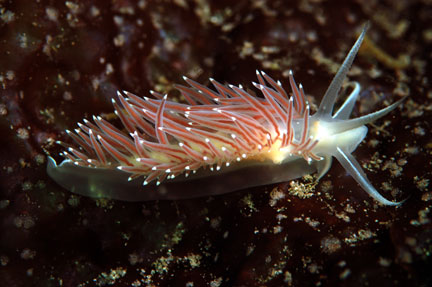
The rock cracks yielded two large octopus, but they were very far in so there was no real way to get any good pictures. I didn't find any wolf eels either. During the whole dive, the stars were the nudibranchs. There were so many, especially the red flabellinas.

(Please note, these are not my images, they are just representative of what we saw)


I saw a new one, the striped nudibranch.


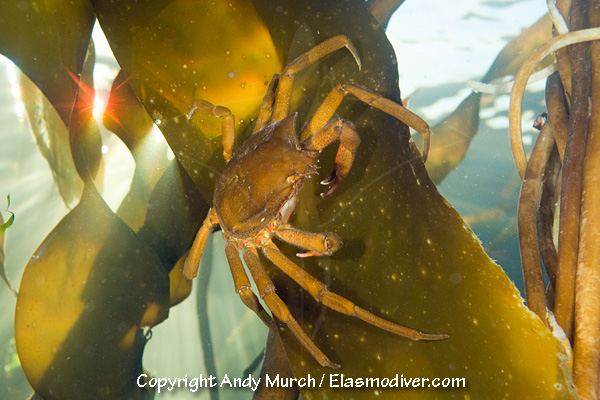
There were also some new ones in the shallows clinging to the kelp (but they might not have been nudibranchs, they could have been some kind of snail). There was a giant white dendronotid, a leopard dorid and an heath's dorid. The kelp and eel grass were festooned with kelp crabs.


There was also another huge bait ball of small silvery fish. I was able to get some video of it this time, and a picture.


I was very happy that I didn't miss the main wall, for Francois sake. I was going pretty fast during the dive trying to find the wall, so it wasn't the most relaxing one. But, after the dive, the weather cleared and Bridget had made some delicious lunch which we had on the beach. Much more relaxing, thanks!!! Francois had his camera along, but didn't think he got any pictures of note. Next time...

10 Mile Point 05/07/2014

Heather had  the Nanaimo Dragonboat festival this weekend, so I took the opportunity to come over and do some diving. I declared all my cylinders as a good citizen should, and got put right at the front of the ferry! Now, I realized though that meant that they would just push the truck off if there was an emergency, but at least I got off first!


We stayed in a yurt at the Riverbend Resort near Parksville, similar to the ones at Porpoise Bay Charters. It was great, there was a fire pit, a gas fireplace, and all the comforts of home, but it felt like you were in a tent! Listening to the rain on the canvas roof was very relaxing.


The first dive I did was with Greg. He had checked the tide charts, and 10 Mile Point was doable. 10 Mile was one of Greg's favorite dive sites, and for good reason. I had done it a few times in the past, and loved it. While often not possible due to the high current, that same current provided food for the explosion of life that lived there. Very very nice for a dive that is basically 10 minutes away from the city. I wished Vancouver had such a dive site. We had an additional advantage in that we planned to bring scooters. This made the dive even nicer, because we could enter the water at Spring Bay and scooter over to 10 Mile. The entry at Spring Bay was so much nicer than the steep rocks at 10 Mile. It also meant that we didn't have to worry so much about timing the tide just right. I got a very nice picture of all our scooters lined up, ready to go.


We were joined by Mark, whom I hadn't seen since the Hornby Island Sea Lion dive. We quickly geared up and were soon scootering over to 10 Mile. Greg ran the navigation, and did a good job as always. It was simple, we took a compass bearing to the point, dropped down and followed the bottom for about 5 minutes. This deposited us right on the wall. We came across another dive team there, but they didn't see us. I had met one of them in the parking lot, his name was Trevor. We stowed our scooters and proceeded to enjoy the fabulous dive: Cabezon, red Irish lords, buffalo sculpin, clown nudibranchs, gumboot chitons, baby Puget sound king crabs, huge schools of bait fish, leopard dorids, the list went on! I got a very small amount of green, grainy video.


These pictures are not mine, but they are representative of what we saw.

Cabezon
Red Irish lord


Clown nudibranch


Baby puget sound king crab


Leopard dorid


The visibility was good, maybe 20 feet. It wasn't the best, but since all the life was up close it didn't matter much. We didn't see any octopus, but Trevor reported during the surface interval that they saw seven! Why couldn't we see even one?

Greg and I did one more dive, and did the same thing again. There was a lot of fishing line and fishing lures littering the wall. You could tell it was a popular fishing spot. All the old line and cast off equipment marred such a nice dive site. That was the only down side. Maybe one day Victoria would make it a marine protected area.

Greg and I finished off a great day of diving with a snack and a hot drink at the Starbucks down the road. I couldn't wait for next time!

Friday, July 4, 2014

Topline Canada Day 01/07/2014

Happy Canada Day!


Jason Kolba messaged me asking if I could come out diving on Canada Day. It had been forever since we had got together for a dive. The day did not disappoint. It was sunny and clear. The picture above was taken by Jan at the end of the day, but I figured it would be great to put it first! Kevin and Jan of Sea Dragon Charters were their usual awesome hosts. They had a three dive day planned, two dives in the late morning, then a dusk dive and fireworks viewing. I only did the first two dives, as I had already had plans that evening with Heather.

On the boat I was not surprised to see Patricia and Andre.They were putting their new sidemount skills to use. Jason also had his wife Pia join us, but she relaxed in Horseshoe Bay while we were out diving.

On the boat ride, Sewell's Marina had their fast boat out, and were using the Topline's wake for some pretty impressive jumps! It was quite a spectacle.


Kevin joked that Sewell's shouldn't be so strict about the no-wake policy, since they were having so much fun using his.

Our first dive site was Halkett Wall, and it was a great dive. When we dropped down, we investigated the crack and rock ledge for octopus and wolf eels but saw none. However, there was a very nice tiger rockfish there. The giant plumose anemones covered much of the wall, and it was really neat to see the sheer rock covered by them. Steve from one of the other groups spotted and pointed out to us a whole mess of Cockerell's Nudibranchs. I had only seen these once before. Later, when we were talking about it, they apparently were seen up in Port Hardy, and it was interesting to see them this far south. Another interesting part of the dive was swimming through a bait-ball. I didn't know what kind of small silvery fish they were, but it was like the big schools of bait fish you'd see on nature shows. Not as thick, but still nothing like I'd ever seen before. It was good to see the little fish, since that meant more dolphins and other bigger things. We also spied a very large heart crab.

On the second dive, we went to Twin Peaks, a new dive site for me. There were two sea mounds close together, hence the name. Jason had dived it before, so he led the dive. It was a lovely little dive. We came across a swimming nudibranch, as well as a fried egg jelly fish caught and being devoured by anemone. I couldn't see how such a small anemone could eat the whole thing, but I guess a bit at a time works! Talk about being eaten alive. Jason also found an impressive decorated warbonnet in a cloud sponge. Very nice!

Here is some video from the dives.


All in all it was a fabulous way to spend Canada Day. When I was driving out, I was kind of sad that I had not worn red. But I realized my drysuit was red, and I even managed to get the Topline in frame for this picture! Jan made me wear the crazy hat in the second picture, and it also turned out great!


Monday, June 30, 2014

Nanaimo Wrecks 29/06/2014

Liz Tribe organized two days of diving on the Nanaimo Wrecks with Sea Dragon Charters. Thanks Liz! I couldn't do both days, but on Sunday I got up at 4:30am to catch the second day. Jim Dixon had dove the previous day with Guy Shockey and they had some great dives and excellent visibility. Jim, Greg and I were all set to poke around in both ships with some fun penetration dives using trimix.

Everyone met at the Harbourside Marina parking lot. It was a nice surprise to see Francois Keen again; I wasn't expecting him on the trip. I met his friend from New Zealand, Kathryn, and his partner Bridget. Liz and Dennis were completing a wreck diver course for Jeff. It was great to see her again too since it had been quite some time. The previous day had rough conditions, but we had a much calmer day. The weather even cooperated (mostly) with some sun mixed with showers.

Liz got a partial shot of the group (missing are Francois and Bridget).


We dove the Cape Breton first. Our dive plan was to descend through the skylight and poke around the lower decks. Greg was running the reel, and his initial choice of path did not get us far. I was in the number two position, and saw him try to squeeze between a railing and a pipe. It just wasn't to be, so we backed out and went down a different passage. It was a fun dive! We managed to get to 40 meters max depth, which was deeper than the sea floor! When the ship sank, the weight of it pushed it down into the bottom. Our average depth worked out to only 32 meters, so we didn't have a lot of deco to do. I had spent less time inside the wrecks than Jim and Greg, and it was great to get inside more. The final room we ended up in was large and spacious, with a lot of interesting rust formations. Back out and up for our deco, we came across the other dive groups heading up the line as well. Francois was taking pictures, and here is one of them. Myself, Jim and Greg are the group of three on the line at the top of the picture. Foreground is Bridget and Kathryn.


It was fun watching the bubbles coming up from below. They looked like big silvery blobs. I made a game of poking as many as I could. Greg motioned me twice during the dive to check behind him. I was baffled as to why until back on the boat. I had forgotten about the rubber chicken clipping prank, and apparently there was a new game of clipping off a little crappy dive light to your butt d-ring. I had to remember to watch my back with these Island diver types! The aquatic life on the Breton was impressive as always, with the huge plumose anemones and cloud sponges encrusted everything.

During the surface interval, we luxuriated on the upper boat deck in the sun (and a bit of rain!). It was great fun talking chatting. Francoise had moved to the Island, so we talked at great length about all the good diving on the Island. He had some great pictures of the sea lions at Race Rocks.

The second dive was on the Saskatchewan, and we planned for a shallower shorter dive. Jim led the penetration, and I did the deco. The first entry we went into didn't get us to the central corridor, and we had to back-track. On the second try, we hit Burma road and explored it until we hit our turn pressure. I distinctly remember being just behind Greg in a cramped passage, with Jim ahead in a nice big open area. Why couldn't we have turned just a little bit later in that big room I cursed to myself! Still, it was fun and good practice turning in such a tight area. In reality, there was loads of room, but it seemed smaller at the time. The side compartments were neat to peer in as you passed by. It was a short penetration, but lots of fun. We had only a small amount of deco to do, as our average depth was only 30 meters and our dive was only 20 minutes. But since we had done a previous technical dive, we made sure to wash out on Oxygen at 6 meters and do 1 meter stops to the surface.

After each dive today, there were excited exclamations of how great they were. Kathryn could not get over the giant plumose anemones and how much they looked like something from Doctor Seuss. They didn't have such things in New Zealand. It sure was easy to take for granted the amazing marvels we have in the BC waters!

On getting back to the dock, the weather turned positively balmy. The sun was out and it was definitely short sleeve weather again. Liz and Dennis couldn't join us, but the rest of us went to Serious Coffee for some food and conversation. It was good to be back in the old Nanaimo neighborhood again! We had a great time talking about Vancouver Island cave diving, watching some of the videos of octopus encounters that I had had, as well as the Hornby Island sea lion video.

It really was a perfect way to end a great day of diving, talking about more diving!

Dive Master Final Pool Skills 28/06/2014

Finally done! I only had the pool skill evaluations and swim test to complete, and got this done finally. Ken Dunlop had a sidemount class in the pool at Simon Fraser University, and Amy was kind enough to evaluate Linda and myself. In a happy coincidence, Andre and Patricia were doing the sidemount class, and it was great to see them again. Heather and I had met them on the Topline in March. I told them that we would get a dive going on the Topline soon.


 It was a packed 3 hours, as we had a lot to do. The underwater gear swap went much better than I had anticipated. Before we started, I didn't realize that it was swapping fins mask and BCD, and that you had to end up in the other person’s gear, all while sharing a single regulator. There was some complication in that my feet were bigger than Linda’s so fin swapping required different fins for both of us. Not something I would ever have thought about to prepare for. Who swaps their fins, ever??? But I understood it was all about problem solving and task loading under water, not realism.

Linda had a good suggestion which helped a lot. We purposefully started out in each other’s gear. That way, as the exercise went ahead, we’d progressively be back in our own gear. It worked great. The rest of the skills went well, with not much to comment on. My demonstration quality was not that great. If I was going to do this more often, practice would definitely be needed.  Watching Youtube videos of the skills helped some, but hurt sometimes as well. Each shop and instructor had a few differences in skill demonstration. So on one skill, we had to do it a different way, which was no big deal. Just a general note, one should not assume that an online video is correct! What? The Internet is not all facts? A good reminder.

Back at the shop, it was a lot of paperwork, and soon, I should get my card!

Porteau Cove 25/06/2014

Vladimir and I met up to do a much-needed scooter dive of Porteau Cove.  It had been far too long since having the scooters out. I had put together a new compass mount after the dive we did at Seananus  and I was itching to see how it would work out. The tides lined up well, which helped visibility. The area had been less than stellar with the water around Vancouver taking on a yucky shade of brown most days. Our dive plan consisting of a deeper average depth of 25 meters also would help.

The evening was perfect when we arrived. However, big threatening clouds looked to be coming over Anvil Island. We could see a big rainstorm pelting down there, so we tried to gear up quickly. I had a small issue when I discovered that my doubles were only half full. I had forgotten that I had been planning to do a practice dive previously that didn't need a full fill, and neglected to check. But, we sorted it out by having both of us take one of my full stages. I would breathe one empty, and then swap it with a full one from Vlad. It would give us some good practice, so it worked out in our favor. All that training was getting put to use!

It did take some time to get in the water with all our gear, and then more time to scooter over to one of the buoys. We made the choice to scooter out on the surface closer to the Nakaya to get out to deeper water. Once we descended, visibility wasn't too bad. We had taken a bearing, and followed it and the 70 foot contour and ran right into the Nakaya. Vlad was leading, and didn't expect to find it so easily. I remember the surprised look he gave me. From there, we headed on with a bearing of basically due north, and hit the wall beyond. It was very cool, and I was glad we came to check it out. When the highway and railway were constructed just above the area, a huge amount of rock had been blasted out and dumped into the ocean. The boulders were truly massive, jagged and jumbled, and were the most interesting part of the dive. There was not a lot of life covering anything, but there was some. One unique thing we did not see often were cloud sponges growing in the crevices here and there, and at a shallow depth of only 20 meters. There were also vermillion rockfish, tiger rockfish and large lingcod. There were some nice big white nudibranchs as well. We also came across a few long old rusty railway rails. It was very odd seeing these rusting bits of metal just lying around. Obviously they had been dumped here too. Maybe it was true what they said, that a railway car was down here too somewhere!

The bottle passing went OK, but we didn't plan so well for the large change in buoyancy. When I passed my empty and very positive bottle to Vlad, I sank and he went up. We recovered, but it could have been done more elegantly. More practice was needed for sure.

We planned for a 90 minute duration, and with the average depth of 25 meters this worked out to be about 15 minutes of decompression on oxygen. It was pretty murky when we scootered in to 6 meters for our deco, but it was ok. We watched the flatfish and Dungeness crabs on the sandy bottom for entertainment.


All in all, if you had a scooter, diving the Porteau Cove wall past the Nakaya was well worth it!

Wednesday, June 4, 2014

Egmont GUE-BC 31/05/2014

I arranged for a GUE-BC trip to Egmont to dive Agamemnon Channel, also known as the Power Lines. Kal from Porpoise Bay Charters was our Captain and boat of choice. I had been on a few trips with them, and each one was memorable. This time, we were not able to take advantage of their full hospitality, since the plan was for a day trip only. It was certainly going to be a long, but excellent day!

Here is a link to the photo album for the trip:

https://plus.google.com/photos/103220399355688115810/albums/6020356839861131361

The overall goal was to get a few technical teams in to check out the Gorgonian corals. This spot was one of a few places where you could see coral similar to what you might see in the tropics. The wonders of cold-water diving never seemed to cease. This coral was also one of the reasons I got into technical diving in the first place. I really wanted to see them first hand!

We met at the Church on Taylor way at a very early hour (most of us had to wake up at 4 am) in order to car pool for the ferry. The vehicles were packed with gear. This picture was only some of it.


I took a quick pre-trip picture. Everyone seemed to be awake! From left to right: Heather, Vlad, Daniel, Josh, Dave, Dennis, and Jim.


We made very good time to Egmont. There was an amusing moment when Dave asked me "how do you get to Egmont?". So much for my extensive planning! I had forgotten to include directions to where we were going. That was easily sorted out, and soon we were at the dock loading the boat with Kal.


And paperwork!


On the way out, Kal gave a quick boat and dive briefing. We had one recreational dive team, and two technical dive teams. Jim and I were using 18/45 to explore a bit deeper. Our dive plan was for a 30 minute dive at an average depth of 150 feet / 45 meters, and a max depth of 180 feet / 54 meters. We had talked to a lot of people, but still hadn't gotten a clear idea where the best coral was, so we were going to find out ourselves.

The coral was more beautiful than I could have imagined. Vlad got some great photos.


I got some video, but it was quite dark. You can view it here. It includes video from the second dive as well. The beginning of the video is the dive on the corals, and you can see some of the coral fans illuminated in our lights. Jim videoed me doing my happy dance underwater during our deco stop.


In the end, coral could be found easily around 130 feet / 39 meters, but it was definitely smaller. The bigger fans were between 140 feet / 42 meters and 150 feet / 45 meters, and the biggest were around 170 feet / 51 meters. The actual area where the coral fans were was not that large. Jim and I didn't spend too much time at 180 feet / 54 meters, but I didn't remember there being a lot of coral there either. This dive would be a solid 21/35 trimix dive, where you'd want to maximize your dive time between 130 and 150 feet. That seemed the most bang for your buck. There was a lot of gas and cylinder logistics, so I could see a rebreather being a good tool here. A lot of planning went into the tides and currents as well. You were quite exposed on this dive site, so dive time was a limiting factor. Anything over an hour total could be an issue, since currents were notoriously unpredictable. Having a long decompression obligation and a strong current could be a recipe for getting separated from the boat. Not a good plan! Kal was very good about helping with this planning, and we made sure he knew what our expected dive times would be up front.

Jim and I had a funny story from our dive. It turned out that both of us had forgotten to set our depth gauges back to metric, and spent the whole dive converting because we thought the other was in metric. Half way through our deco, we had a good laugh when we compared gauges and realized that.

Surfacing brought us back to the beautiful scenery around the Power Lines.


Here was a great reason why Egmont was always so awesome. The visibility was so good, you could see the dive teams on their decompression stops from the boat.


We had a long surface interval due to the tech dives, so we motored slowly to Captain's Corners, another dive site nearer to the Government dock where we started. Captain's Corners was known for its beautiful cloud sponges (much like the power lines was). Along the way, Ann had prepared a nice lunch for us with cold cuts and all the fixings to make sandwiches. Even vegetarian Jim got some Tofurky! They thought of everything.

On Captain's Corners, I did a recreational dive with Heather, and we got some pretty nice pictures. In the video I mentioned above, there was a really great sequence of a lion's mane jelly fish, and a cloud of microscopic shrimp creatures trying to escape in front of us. The dive was nice and relaxing, with very little current.

There were some very beautiful giant dendronotid nudibranchs.


And this was a nudibranch I had not seen before. The first photo captured the light of another dive team off to the left.


The cloud sponges at Captain's Corners did not disappoint.


With the second dive done, we made a quick dash back to the dock, packed up and were on the road to catch the 6:50 PM ferry. While not too rushed, we certainly didn't have time to dawdle. But we made the ferry in good time. With the amount of cylinders we had, we declared our dangerous goods for BC Ferries. Dave had a small problem on the trip back. The Supervisor cited regulations that all dangerous goods had to be covered. I'd never encountered this before, because almost always cylinders were in a covered vehicle. Covering them with a tarp solved the problem, go figure. It never ceased to amaze me the difficulties that could be had when declaring dangerous goods. If only it was easier, a lot more people would actually do it!

And finally, one last group picture.


Sunday, May 25, 2014

Furry Creek Underwater Map 24/05/2014

Part of the Divemaster course was to complete an underwater map. I had helped my friend Jason Kolba do one ages ago, at Copper Cove. Shawn, Michael and I teamed up to do an underwater map of Furry Creek. There seemed to be a distinct lack of information on the dive site. I knew people dove there, but unlike a lot of other sites, Furry Creek seemed more word-of-mouth. I had my notes in a previous blog entry, and also found another description on Scuba Board.

We arrived early, and planned for three dives to map the 70, 50 and 30 foot contours. A new addition to the dive site was a port-a-potty up near the condo complex. I wasn't sure how long this luxury would remain, but it was a nice addition for those who need facilities!

It started out quite cloudy, with heavy rain on the drive to the site. Fortunately the rain held off for the rest of the day, and it turned sunny by the time we were done. This was a picture facing south.


We had quite the day for wildlife too. There was a turkey vulture presiding over the site when we arrived.


Hummingbirds were also buzzing around. The picture I got was very grainy, which was too bad.


In addition to those, there was a blue jay, and a weasel-like creature called a fisher capering around the beach. I'd not seen a fisher before, and it was pretty cute. Underwater, we saw a variety of small cloud sponges, rockfish, kelp crabs, plumose anemones, juvenile lion's mane jellies, and lots of coonstripe shrimp.

Here is a bit of video from the dive. Mostly dark, and green!


We first had to figure out our kick cycles versus distance. With a thick layer of white sediment in the top 10 feet of water, we decided to do this at the surface. I had brought along my underwater tape measure, so we ran out 100 feet. With three people this worked well, because 2 could hold the tape while the third swam the distance. There was a bit of a problem with timing though. Mike's and Shawn's computers would not show seconds, and I couldn't get my Xen bottom timer to go into stopwatch mode unless it was below 5 feet. Later I figured out that I could have put it into dive simulation mode, and get access to the stopwatch, but that didn't occur to me at the time. Anyway, it wasn't a show stopper because counting in your head worked just as well. Following the tape reminded me of the zero-visibility training I had done in cave diving. You really couldn't see anything. All you could do was keep an eye on your compass and depth, and your fingers around the line. For me, it took me 49 frog kicks to travel 100 feet, in 48 seconds.

For the first dive, Mike was in charge of noting compass heading and kick cycles. We decided to swim out to the white marker buoy and descend there. The idea was to use the readily available landmarks that divers would tend to see and use. It was a good thing we did, since the visibility was very bad for the first 15 feet. However, once we got to 20 feet, it was quite good. We grouped up at the bottom of the buoy chain, which was at 18 feet (it was low tide). There were two large concrete blocks there as well. Mike then took us down to the 70 foot contour, which went kind of north and that took us 3 minutes to get to. Once on the 70 foot contour it took us about 5 and a half minutes to run into the wall. Right there were small cloud sponges. Following the wall, it stayed pretty constant. The sandy bottom was at about 80 feet below us, and while the wall wasn't covered in life, there were tunicates, and many cracks that critters could live in. We weren't on a sight-seeing dive, however. It was quite dark too, as the bit of video I took showed. But the visibility was good. Our dive plan was to ascend at the end of the dive where we were to get an idea of how far along the shore we were. This would allow us to plot the underwater contour with reference to the shoreline. But, it meant for a long surface swim back!

On the second dive, I was leading. Our dive plan this time was to surface swim out half-way along the wall and descend there to find the 50 foot contour and follow it back south. There was no point following 50 feet along the wall to the north. On the descend, we weren't close enough together, and lost Shawn in the first 15 feet of water. We regrouped on the surface, and made sure to stay much closer together. I could hardly see my hand in front of my face! But again, at 20 feet, it was fine. The dive plan worked very well. Where we descended we got onto the 50 foot contour bang on. Following that led us through a bottle pile, past a chain attached to a crushed plastic blue marker buoy, and through various rock fields interspersed with sand.

Shawn led the third dive, and we used the white marker buoy again as a start-point. The plan was to head along the 30 foot contour to the wall, surface, swim back to the buoy, then head south along the same contour. It all went according to plan. On the way to the wall, we came across a chain attached to a block (the remnants of an old marker), as well as a debris field with bottles. It only took about 5 minutes to reach the wall. The rest of the 30 foot contour south was all pretty much sand. Near the end of the dive we passed the red marker buoy chain, which was another good landmark.

All told, I think we got all the information we needed to do a pretty good map! Now, to get that done!

Update: Here is my completed rough map.


And here is the final good map that Michael did.


Monday, May 12, 2014

Dragon's Den and Route 66 11/05/2014

Heather and I went out on the Topline with Sea Dragon Charters on Sunday. Boy am I glad we did, the day was amazing! We visited two dive sites off Anvil Island, Dragon's Den and Route 66. Route 66 was on the east side of the island, and was a newly-discovered dive site. Kevin and Jan were both on board today, and reported that the visibility had been great lately. Some dive teams reported being able to see the boat hull from 60 feet. I had my fingers crossed!

If you'd like to see all the photos we took, check out this album:

https://plus.google.com/photos/+AntonNorth/albums/6012560478527193265

I can't go farther without first sharing the best octopus encounter we'd had in a long while. I will explain more later on!


The day started out cloudy and threatening, but the weather report was correct. It turned into a beautiful day. Here is a picture of the first dive site, Dragon's Den.


It was a treat going up to Anvil Island, because it was a bit of a long ride and often the weather and other factors meant it made more sense to go to sites closer to Horseshoe Bay. Not today though!

I put together a video compilation of both dives here. The first portion was with my GoPro camera. The rest is using Heather's Panasonic camera with Sola light..


Visibility was indeed excellent. There was a murky surface layer, but under 20 feet it opened up to at least 30 or 40 feet of visibility. There was a great portion of video with bubbles trailing up to the surface. On the Dragon's Den dive, we saw a lot of critters. There was a cute red fur crab inside a cloud sponge (and a squat lobster poking its claws out).


The Dragon's Den was so named due to the small caverns that were there. There were three of them, around the 70 to 80 foot depth. They extended back maybe 20 feet, and were more like big rock overhangs. The ceilings were covered will plumose anemones and tunicates and star fish. We discovered our bubbles would knock off the starfish, so a few times it was raining starfish! This photo showed kind of what the roof was like, with a little decorator crab front and center.


The plumose anemones around the Dragon's Den site were very pretty as well. Another decorator crab was hiding among them.


We had a nice relaxing surface interval in the stunning scenery of Howe Sound. I had to take the requisite panoramic shot!


For the second dive, it was Route 66 a site no one on the boat had done before. Kevin and Jan reported that when they found it, all the good life was around 60 feet. We couldn't wait to get started!

We spent our dive around 30 feet, and it was a good thing because about half way through, Heather spotted a nice sized giant pacific octopus taking a nap on a rock! You could tell it was a giant pacific octopus and not a red octopus because it didn't have paddle-shaped eyelashes under its eyes.


The octopus wasn't too thrilled to be disturbed, and put on its threatened display several times (changing its colour to white, and flaring out its mantle). We let him be as much as we could, but we weren't going anywhere until we got a good look! The video at the top of the page turned out really really well. The pictures of the threat display were also awesome.


Sadly we had to leave him behind and continue with the dive. The visibility was as good on this dive as the first. We saw a barnacle eating nudibranch, alone without its usual friends.


Decorator crabs were everywhere. Some of them were more decoration than crab!


There were a ton of sea squirts covering everything.


A small heart crab tried to escape from us by jumping off a rock, but we followed him and he finally sat still for this picture.


Coonstripe shrimp were everywhere on this dive. Near the end of the video, you can kind of see them running away from us.

Finally there was some strange tunicate that I had no idea about. It looked like it had something inside of it.


The day came to a close far too soon. But we capped it off with snacks and drinks on a patio in Horseshoe bay. Cant' wait for the next time we go out!

Monday, May 5, 2014

Dive Master 01/04/2014 - 04/05/2014

For a long time, I had thought about completing the PADI Dive Master course. Much of my time and training had since gone towards Global Underwater Explorers, but I liked the idea of having a very recognized accreditation like this. Many times I had gotten blank stares when I have said "GUE", but everyone recognizes PADI.

I felt that at this point in my diving career, I could with confidence say that I am a "dive master". There were other reasons as well, one of which was to remind myself of how most of the world dives. We all have to start out somewhere, and PADI was a good starting point for many (myself included). It would be good to review the system I learned to dive with, and be comfortable and knowledgeable in it again. That way I could "lead by example" and show people there are other ways to dive and why practice and skill was important.

All my training had been through the International Dive Center, and I also thought this would be a good opportunity to diversify and go through a different shop. I knew quite a few people who used Ocean Quest, and thought that Ken Dunlop would be just the kind of instructor I was looking for. I had known Ken for a while, and liked his easy-going attitude and practical approach to teaching. He seemed just the right mix of professional and fun. I had taken an Oxygen provider course through him one time, and I really enjoyed his teaching style. I hoped that one day I could be as good an instructor, if I went that way! During the course, Ken got his Platinum Instructor certificate (something like that) from PADI, for certifying I think over 250 students in a year. Quite an active guy!

Since I wasn't in a rush, I didn't have any specific plans on when to do the course. However, when Ken emailed me saying that he was doing a dive master course starting on April 1st, I jumped at the chance. The timing worked out perfectly. I chuckled a bit at starting on April Fools! Hopefully he wasn't joking.

I worked through the online material in a week or two. I was impressed with the quality of the material, which was definitely something that PADI does well. I did find a few mistakes with links to Project Aware not working, and it was crappy that you couldn't do the online portion on an iPad. The online portion was done in Flash, and unfortunately this was a poor choice, since many devices don't support Flash. The material relied heavily on audio and some video. Each section had it's own little quiz, and there was a bigger knowledge review later. I was frustrated in that for the quizzes, if you got a question wrong, you couldn't go back and correct it without doing the entire quiz again. Each quiz would not let you proceed until you got 100%, which was very annoying. There was a lot of material that I had forgotten about, mostly to do with specific PADI standards and ways of doing things. The legal section was dry but interesting, and it was a good review of the PADI tables. I think I liked the physics section most. It was quite good.

The first day of class was mostly paperwork. We all introduced ourselves, and it was nice to have a fairly small but diverse class. Ken and Amy were filling the instructor role, and the dive master candidates were Travis, Linda, Michael, Shawn, Holland and myself. Ken made a point of saying the new trend for PADI was to start emphasizing getting skills done while not kneeling on the bottom. I thought that was very nice to see.

The first pool session happened that weekend, and the first session was mainly going over the 20 skills. It was a long session in the pool, I was glad I wore a full 3mm wetsuit. Amy and Linda got extremely cold. The first dive was an hour and ten minutes, and the next one was half an hour. I had some real fun with the underwater gear removal as I didn't have a weight belt. I would remember that key piece of equipment next time! I don't use a weight belt any longer, and never thought that it might be required. I practiced skills a lot in the ocean, so that helped but the 20 skills were supposed to be done "demonstration" quality, so there was a lot of over-emphasis and small additions that you would normally not include when doing them. Not to mention that there were a few like the underwater gear-swap that were not included in GUE. I could see the value of introducing a complex task, but the practical application of it was next to zero. I wasn't complaining, I had fun. There was even some entertaining video of me attempting the famous "yoga" hover. I will stick to horizontal hover, thank you very much!

Amy and Ken took some video in the pool. I am the one in the full wet suit, with blue arms and black mask. Looking back, I should have focused on maintaining my usual buoyancy and trim. I remember many of the comments from Alan Johnson and Guy Shocky to keep striving all the time. Just because something wasn't a requirement doesn't mean you should ignore it!


There was also an opportunity for a group underwater picture. I am on the far left. From left to right: me, Travis, Michael, Linda, Shawn, Holland.


The next pool session was with actual open water students. Brian was the instructor that I worked with, along with Michael. Michael and I were lucky in the groups, sorry to everyone else! Brian had two students, Ryan and Daniel who were doing their drysuit checkout. The other two groups had only one student each. Talk about fighting for students! Since our group had two students, and two dive masters and one instructor, this meant that each of us had one student each. I was sure this would not be a luxury often encountered.

Brian's feedback to Michael and myself was positive. He farmed out skill demonstrations while he completed a skill with one student and the other dive master. We demonstrated and supervised mask flood, removal, regulator recovery, hover and participated in air-sharing. Brian said that our hand signals and demonstrations were slow and easy to see. For myself, I knew that the time spent reviewing this demo video that I had found helped a great deal.


I remembered more about skill exaggeration and added more reminder steps that I might have otherwise forgotten. I could see how easy it would be to forget all this stuff if you did not review. Brian's biggest comment was to always remember to be in good physical contact with a student at all times when mask skills are being done (and to be close at all times in general). Also you should be in good physical contact when the regulator was not in their mouth, and to have your alternate in-hand and ready to go into their mouth whenever the regulator was out of the student's mouth. Brian said this was good practice for instructor training, and just good practice in general. I know I completely forgot on several occasions to have a positive hold on my student. And not just a finger on a strap! While it was our responsibility to keep a student safe, if something happened the instructor would also be liable. So it was in the instructor's best interest to make sure you had a good hold, and had that alternate ready.

The other comment from Brian was to remember to give a student some lee-way to learn, especially on hover skills. There was a fine line on interfering by grabbing and keeping them down which ended up actually helping too much. Brian said (and I think Ken said the same thing) he would frequently let a student go, and motion for them to come back down and see what they would do. I could certainly see there was a lot of finesse involved in letting a student learn and practice, as opposed to hindering and doing it for them. No one could learn without a few controlled mistakes! I was impressed with Brian. He was an attentive and excellent instructor, in constant communication and kept things moving. He was business when it needed to be business, but fun. I was also impressed with my student Ryan. He understood his dry suit skills quickly, and was hovering horizontally very quickly. We spent a good session working on his breath control, and he was beginning to master it to move easily up and down in the water. I made sure to congratulate him and let him know his achievement, and could see a successful road ahead in his diving career. I know I learned a lot during this session as well.

The next class session had us doing physics, and it was a lot of fun. There were some dry parts, but on the whole it was good. Ken made some very good jokes.

We had an open water session next. The schedule had called for two days in the ocean helping supervise students, but the open water class had a rash of drop-outs, so there were only two students left, Ryan and Daniel. This meant that having 6 dive masters just wouldn't work! Ken split up the group into 3 on one day and 3 on the other. Michael, Shawn and myself did the first day. We couldn't have asked for a better day. Spring had definitely arrived! We all met at Ocean Quest first, and I made sure to give my condolences to Greg, whose mother had just passed away recently. We packed the van and headed to Whytecliff.

We went over a Dive Master briefing at the site, and got our gear together. Once the students were set up, I volunteered to give a site briefing. The first dive was just a dive, no skills. It turned out to be very challenging, as the visibility was extremely poor. I could see maybe 2 feet in front of me, and the students were churning up the bottom even more. Still, we accomplished the dive, and everyone stayed together.

After a very pleasant surface interval on the beach, we were back in the water for the skills portion. This time, it went a little bit worse. I ended up losing the group, and so did Michael. We regrouped on the surface, and found their bubbles and rejoined them, so we didn't lose them for long. It just went to show how bad the visibility was. At one point in the regulator recovery skill, Ryan reached back for it and smacked Michael in the face. I saw it all happen in slow motion, like a slap-stick comedy. It certainly didn't hurt, but was very funny to see.

Brian had some good feedback after. In such poor visibility, you had to get right beside the student so you could see them as well as the instructor. Brian's words were he'd rather need to tell you to go away than have to come get you. If you couldn't see the instructor you couldn't see signals or instructions. This was probably one reason why I lost the group, because I didn't know what the task at hand was. Even though the visibility was so bad, it was probably the best thing that could happen. Experiencing the worst case was definitely a way to learn some things!

After a class during the week, and the first part of the exam completed, we were out in the water again. This time we were at Porteau Cove again assisting instructors with open water divers. It was a pretty nice day, but a bit chilly. I was glad it wasn't raining! For the first dive, it was myself, Holland and Mike as the DM candidates, and Alexis for the instructor. She was taking 4 students out on a buoyancy dive. Two divers, Dave and Sarah were very new to diving and drysuits. They had learned in the tropics and fell in love with diving. Now that they lived in BC, they wanted to keep on doing what they loved. There were two teenage boys as well, whose names have escaped me. Visibility was a challenge again, since there was a lot of sediment stirred up. But we managed to find the fire hose and went for a short dive which was pretty good.

I learned the importance of awareness in big groups with low visibility again. You couldn't just focus on your student diver, but had to expand your awareness to include at the very least the instructor, and hopefully the other teams as well. My student Dave was very comfortable in the water, despite being very new to drysuits, so I was quite lucky. Our group had a weighting issue at the start with Sarah, emphasizing the importance of doing a good weight check prior to starting the whole group out. It was a nice day so sitting in the water wasn't a big deal, but you could imagine if it was poring rain and cold! Doing everything you could before hand as a DM to keep the dive going smoothly was very important. I'm sure it would start to become much easier over time, with practice.

For the second dive, there were two parts. A discover scuba part, and a rescue part. In the discover scuba part, Holland and I simulated a discover scuba open water dive. It went well, but was pretty artificial. Ken gave good feedback in that if your student looked comfortable, there was no need to hold on to them. If they looked uncomfortable, you should move in. Watching your student was very important too! I happily motored ahead, and Holland had a tough time leading the dive. Keeping in control of leading of the dive was important. Ken said this was a tough skill to master, because you couldn't let them get away from you, but you also wanted to give some freedom.

The rescue scenario had three big bits of feedback from Amy. One, slow down, two remember sequence, three, don't get so caught up in gear removal that you miss rescue breaths. Mike, Holland and myself all got frustrated during the scenario. The key to remember was that it was training. It was the time to take things slow, and think them through. Mistakes were ok, and there was no rush! This was the time to learn, not do it perfectly.

The next day, we were lucky enough to go out with Sea Dragon Charters, on the Topline with Captain Kevin and Chris. Ken arranged for a bunch of Ocean Quest side-mount divers to come out to give us some practice being DMs.

There ended up being a lot of good opportunities for learning. I think Ken even gave some groups private instructions to make our lives "interesting". Holland and I were paired with Arnie, Steve and Dave. We dove the east side of Bowyer island, on the wall there. Visibility was not bad, maybe 20 or 30 feet, but with a group of 5 it was definitely a challenge to keep the group together. We saw some great cloud sponges and boot sponges during the dive. I noticed Steve's SMB line spooling out behind him and could have entangled him. I went in and took it off, spooled it up and put it in my pocket. He ended up thinking he lost it, making me realize I should have made him aware of what happened, and gave it back at the time I fixed the issue. As Holland and I were on single tanks, we had less gas volume than our side-mount charges. So we signaled the rest of the team to keep going, and we began our ascent. The best part of the dive was in the last 20 feet. I found a nudibranch that I had never seen before, the Cockerell's Dorid. It was very small, so I might have just been missing them all this time. Anyway, I was quite excited to see such a colorful little critter. Here is a picture (not from me!).

Nudibranchia (3030943721)

Visibility was a challenge on the descent for the second dive. We got more separated than I liked. I lost Holland for a time, and was ready to tell the team to carry on and go search, when I saw he was back with us. One thing I learned on this dive was the importance of identifying something on every diver so you can recognize them. Also, I learned the importance of not getting confused when another group crossed your path. Making sure that your group doesn't get mixed up was very important!

For me, one of the biggest things I learned was that I was too passive on the dives. I needed to communicate more with the divers, and interact more. My problem was that I felt like I was interrupting their dives. But there was a difference between interrupting and just communicating. Diving dissimilar systems (single tank versus side-mount) was also a challenge.

The day was go go go from the start, because it was a big group and the Topline had a second charter that afternoon. We had to be back by 1pm, so there wasn't a lot of time for relaxing and chatting. We all did a very good job of keeping things going. It's too bad we didn't have more time, I would have loved to have switched up the groups for the second dive. But the time pressure was too much, and the simple task of "switching" up the groups would have been monumentous. Finally, there were 4 gear problems fixed during all of this. Ken fixed his rebreather, I had a leaking first stage, and there were two drysuit inflator hoses that needed to be swapped out. All in all, I don't think we could have packed more good experience into one day!

Our next and final dive for the official dive master course was a deep dive, a search and recovery dive, and a rescue dive. All this took place at Whytecliff Park on a Saturday. It was a long long day, we arrived at 7:30 am and were not finished until 3pm. Even though I got to the park at 7:30, there was already a group there. Once everyone arrived, we started putting together gear, and Ken gave a briefing. My group would be myself, Michael, and Fiona, with Amy as our instructor / videographer. Michael took a challenge to clip on an AL40 as a spare cylinder. The dive was to 100 feet for about 15 minutes, and during that, we had some task loading. At the start we recorded our depth, pressure and time, then at minute 15, did the same thing. This was used later to calculate our surface consumption rate for a dive of moderate effort. There wasn't a lot to see on the dive itself, because we swam across the bay which was all sand. We ended up swimming all the way across, and had to turn around lest we continued on around the second island. On the way back, we met up with the other group, and were careful to make sure that both groups didn't get mixed up. On the ascent, we did some stops along the way, and Fiona deployed her SMB. We also had an out of air situation, with Fiona simulating going out of air. All that worked out quite well. Amy commented later that we did pretty good. The stops took longer than planned, due to the SMB deployment, but that showed the effect of task loading.

Back in the parking lot, Ken went over the next dive. We did some knot tying practice, brushing up on the bowline, sheetbend, and clove hitch. Part of the dive would be to attach a lift bag to the object that we were to search for and recover. It took quite a while to get everyone on the same page with the search pattern. But once that was done, it went pretty well. Our group was to start at 30 feet and go shallower, while the other group would start at 10 and search deeper. The object was supposed to be in 20 feet. Our group would have found it right away if I had not taken us out at too much of an angle. Ken mentioned later that he saw our lights go past. Oops! Still, it worked out ok, because we finished our search and the plan was to surface after 20 minutes and see what the other group found. We did so, and saw their SMB so we swam over and descended and grouped up. The final task was to attach a lift bag to the object (a weight belt) using the knots we learned, and get it neutrally buoyant. This all went pretty well, but the visibility got pretty bad with the bottom being stirred up. After that was complete, Ken had Michael and myself do a quick scenario for Fiona because she needed to finish a requirement to supervise divers with an instructor. We did an air-share scenario, and a regulator recovery. During this, Ken had briefed me to simulate a "panicked" diver for Fiona to deal with, which I did and that all went well too. She was kind of surprised when the panicked diver stopped and motioned for the drill to be cut!

The final thing to do was get graded on an unconscious diver rescue. This also went well. I went slow, and focused on the sequence. By this time, it was nearing three in the afternoon. It had been a long day!

There were still some components to the course that needed to be finished, most notably the underwater map creation, part of the written exam, the swim test and demonstrating skills in the pool for evaluation. But, the open water portions were all complete. I figured in another month I'd have the actual certification card. So I'm going to finish this all off, and end this post here!