Off to Whiskey Cove again for some crabbing again! Actually, we ended up not doing any crabbing at all, and it turned into a fun dive day with skills. Originally it was going to be Heather, Wendy, me and Josh, but Dave and Vlad also came along. It was a very wet day and it was back to regular BC diving weather from the hot summer! With so much rain, we stopped at the Belcarra picnic area and got into our suits there. Heather got this picture of Wendy on dive two, to show you just how wet it was.
And here was me gearing up.
Heather and Wendy formed one team, and I went with Dave, Vlad and Josh. Josh wanted to do some stage bottle practice, and Dave was trying out a new light. On our first dive, we checked out the rocks to the right. Visibility was alright, but not great. There were quite a few schooling perch as well as rockfish. I could have sworn that I saw some black rockfish, but they were probably just juvenile copper rockfish with a darker colouring. The dungeness crabs looked bigger this time around (they were very small last time). I was hoping for more nudibranchs, but I only saw one yellow margin dorid. We also came across some of the rock overhangs that the 151 Dives book talked about. They were not caves in any way, but some of them were a few feet deep. The one we found was about 20 minutes into the dive. On the way back, we passed Heather and Wendy doing their first dive, then Josh and I did some stage bottle practice.
Dave had to go home, but Vlad, Josh and I did another dive doing skills and it went well. Whiskey Cove was quite good for that. There were many concrete blogs and chains from the floating docks above, giving a lot of good reference points. You did have to watch where you surfaced though.
I got some video, too. The giant moon jellies were very cool! We also found some treasure, some lost dive weights. Vlad got to try out a PVC tube that he had put together that could be used to hold stuff like that, or used to clean up line or other garbage from the bottom. It worked pretty well, and was better than trying to carry things in your pockets.
While we were in Hawaii, there wasn't just diving. We also went snorkeling!
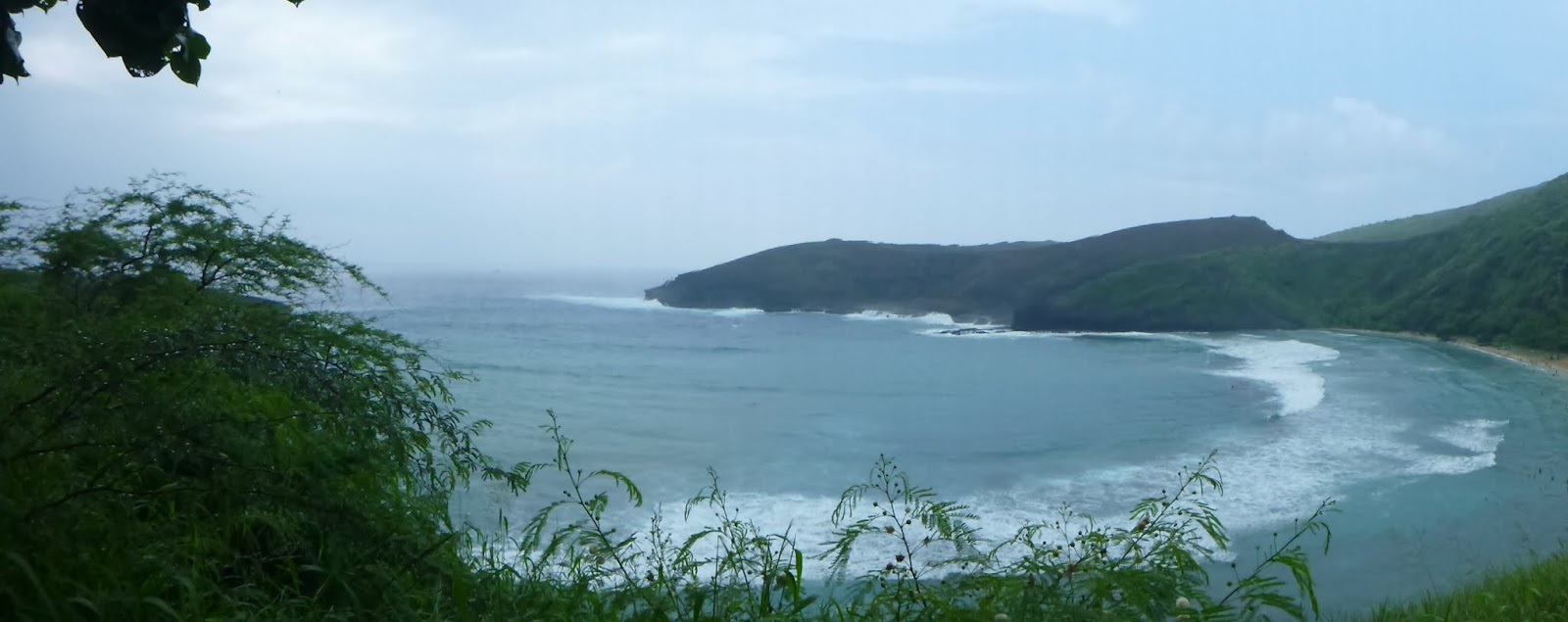
We had heard a lot about Hanauma Bay, and arranged for a trip out there. Unfortunately the hurricane north of us had quite an affect on snorkeling. Here was our first view of the Bay. The surf was crazy! We heard the people manning the visitor's center comment that it was never like this.
The waves out at the point were impressive.
Unfortunately, the visibility in the bay was only a few feet with an incredible amount of stirred up silt. Also, the surge made snorkeling not a lot of fun. Instead, we hung up our snorkels and played in the surf, and laid on the beach. We also saw one of the mongoose that lived in the area, as well as some of the feral cats. Very cute!
When we were leaving, this was a picture of what the bay should have looked more like. But we couldn't stay.
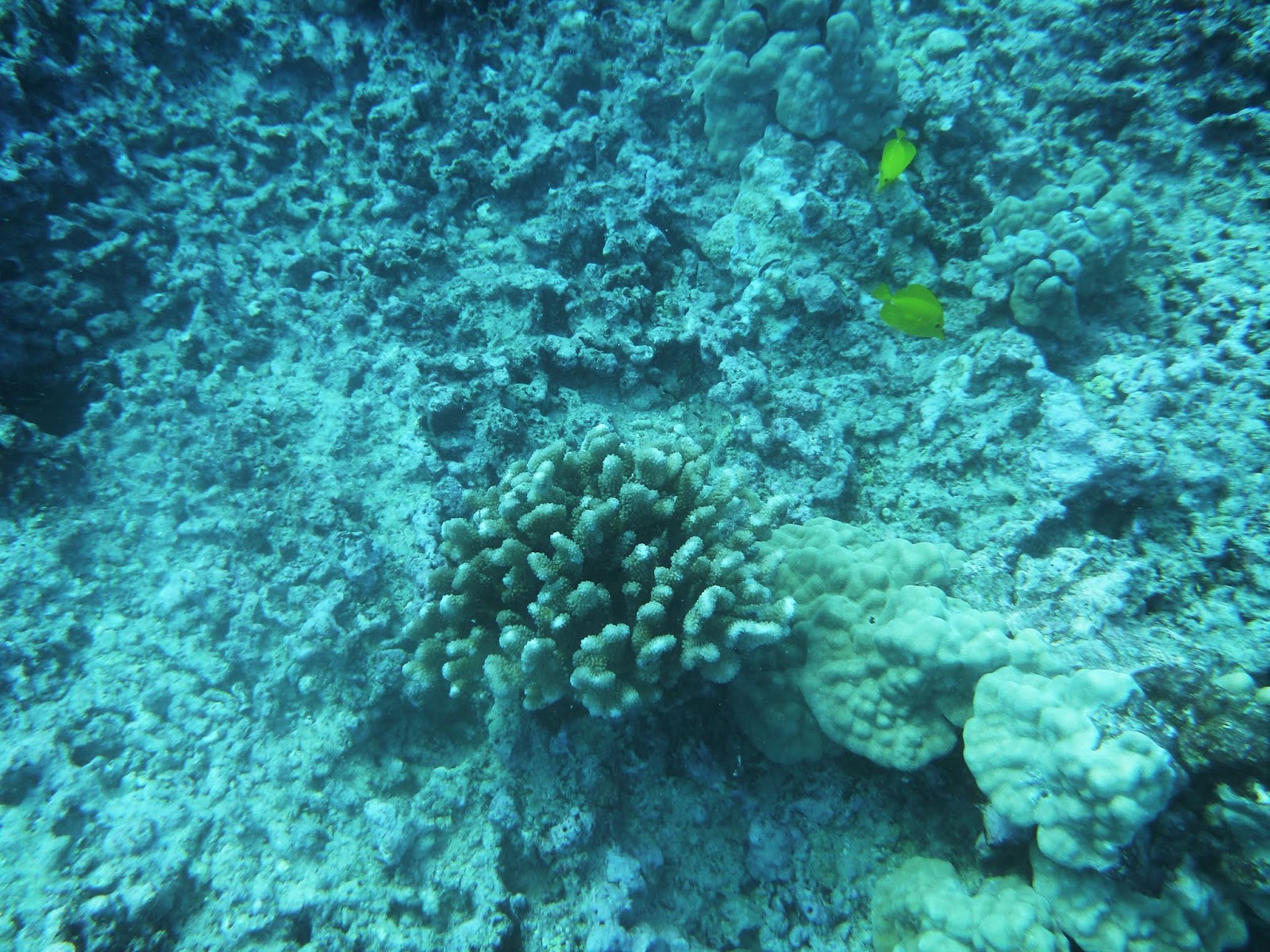
We had a lot more fun snorkeling on Waikiki Beach just out front of our hotel. There was a lot to see! We saw a scorpionfish, schools of reef fish, and some pretty nice coral.
Look closely for the scorpionfish!
The video that we got turned out pretty good too!
It was too bad that Hanauma Bay wasn't the greatest, but puttering round in the shallows at the beach was almost as good.
It had been a long time since we had done any warm water diving, and Heather arranged for us to do some with Dive Oahu while we were in Hawaii. I had never been to Hawaii, and it was an amazing time. We had a lot planned, with diving and snorkeling just a portion.
We got picked up from the Hotel by Tiffany in one of the Dive Oahu vans. As it always seemed with diving, it was early! We hoped that going out early in the day would pay off. There had been some hurricane activity, with Hurricane Jimena to the north, and the surf was definitely up. We also hoped that this wouldn't affect the diving too much!
When we got to the dock, we realized it was just a few minutes away and we could have just walked. At the dock, we met the rest of the crew: Captain Matt and Brian, as well as the rest of the people on the boat. It was a small group, only six of us. A picture of our boat, the Ocean Spirit.
In the waters just by the dock was a school of Moorish Idols, and a zebra moray. I couldn't believe that we were seeing things right in the marina!
Here was a picture of Tiffany and Brian (in the back) talking about our first dive site, the Sea Tiger. The wreck had quite a history.
The day was perfect, as you could see by this picture of our trip out of the marina.
And here was a picture of Captain Matt, taking us out on this perfect day.
The Sea Tiger wreck did not disappoint. We got some pretty neat pictures on the descent.
It was a deep dive at 100 feet and we saw more Moorish Idols, moray eels, white tipped reef sharks and just an incredible array of life. At the beginning of the dive, Heather came over to me and showed me her camera housing. It was sloshing water, and clearly flooded. The o-ring must have not been seated properly, but getting a waterproof camera inside a housing paid off! After the dive, it was fine.
This was a pretty good picture of one of a white tipped reef sharks cruising by. It was at about 130 feet, and we were at about 100.
And here was a snap of the bow of the Sea Tiger.
There was quite a lot of surge and current on the dive, much more than I was used to. It wasn't bad, and made the dive fun and challenging. It was apparent that going out early had paid off, as we watched more and more boats coming out behind us. The dive site was only about 10 minutes from the harbor.
We had a short surface interval, but our next dive site was very shallow with a depth of 40 feet. Tiffany and the crew were keen to get us to Horseshoe Reef ahead of the other boats in order to check out the turtles before they got too overwhelmed with divers. It paid off.
This was a snap of the reef itself. It was not as vibrant as I might have expected, but pretty good considering all the traffic it got and its close proximity to Waikiki. It was literally just 10 minutes out.
Heather got a picture of me checking out the reef.
We both brought Sola dive lights along, but I kept forgetting to use it to illuminate things when I was using my GoPro. I was used to my HID light, which just washed things out, so I was in the habit of pointing my light away.
This was a picture on the way to the turtles. There was a ledge under-which they slept quite often.
The surge here was even more pronounced. It was nearly impossible to fin against it, so it was much more efficient to not fight it, and fin ahead on the surge, almost like a drift dive with a push. The sand on the bottom stirred up in what reminded me of underwater snow-storms. It was quite cool, even though it brought the visibility down.
Tiffany got us over to the turtle area, and from that point, it was just magical. There were about five of them. Patient watching paid off, and I was lucky enough to have several encounters with them. It also gave an opportunity for us to use the picture-enhancing software Vivid-Pix, which helped out quite a bit on the clarity of some of the photos.
This was probably the best shot, with one turtle swimming right past my camera!
Too soon, it was time to ascend and pack up. I couldn't not include my signature self-portrait from turning off my GoPro!
It was a great morning of diving, all thanks to Brian Benton and his crew at Dive Oahu! Here was the video that came out of the day. It turned out great! Enjoy!
Heather and I had talked about going crabbing off and on for quite a while, but never quite seemed to make it. We had several books, and even attended a "how to crab" session at one of the marine stores in town. We had the crab sizing tool, marine fishing licenses, a crab bag; pretty much everything you would need to go do it. We just hadn't gone!
So, we finally took the opportunity to knock two things off our list: go crabbing, and explore a new dive site. Specifically, Whiskey Cove near Belcarra. I had heard of it, but had never dove it before. Wendy from Heather's office also took the opportunity to come along.
Getting to Whiskey Cove wasn't hard, but it was a bit of a drive, and the directions we had left a bit to be desired. I found the best way to plot your directions was to use the bus stop, that is located right there.
There was space for maybe 3 or 4 cars to park. The trail that leads down to the entry was clearly marked as well. We made a note to be quiet as well, since the beach is right between several houses. Conscientious divers would make for happy residents, and no nasty articles in the newspaper! Wendy got a good picture of what the entry looked like at low tide.
I would certainly recommend aiming for high tide when diving here. Also, there were many docks and boats, so you really needed to watch where you ascended at the end of your dive.
The dive went pretty well, but we didn't succeed in keeping any of the crabs we caught. All were under the size limit. There were also an incredible number of females, which you couldn't keep. Out of maybe 15 crabs that we inspected, only 2 of them were males, and both of them were too small. Still, we could see why Whiskey was a popular site for crabbing. There were loads of dungeness, as well as red rock crabs. The dive itself was shallow and easy. We went along the rock wall on the right side. You might make 15 meters or 50 feet of depth if you were lucky.
Visibility was pretty good as well, despite the recent storm we had. We even managed to get a few photos. Here was the prey. They sure could pinch if you didn't grab them right! I wore wet-gloves for the first time in 5 years, and that worked out pretty well. I didn't have to worry so much about the claws cutting my dry gloves.
We also got a funny selfie at the surface, when I was mucking around with the camera.
We also came across some nice moon jellies.
Finally, we even managed to get a very short bit of video.
All in all, a lot of fun! We would be back, hopefully when the crabs had grown a bit bigger.
It had been some time since I had been out for a scooter dive, and Vlad and I decided to join the Whytecliff Wednesday crowd to change that.
Arriving on a perfect evening, we got ready for our dive. Vlad had taken his scooter down to the beach, and when I went down, I couldn't see it at all. My first reaction was that it had been carried out by a wave, but then I found it. It was behind a log that made it difficult to see from the path.
The tide was going out, and the visibility looked not too bad. Our plan was to scooter from the bay past the Cut, and then back. The first 15 meters of depth was pretty murky. But beyond that it opened up fairly nicely. We ended up seeing a great deal of life, and it was a great dive.
At the beginning, we came across a tiger rockfish near the day marker. They were not very common as far as I have ever seen, so it was very cool. 15 minutes into the dive, we also came across a lion's mane jellyfish. I got a too up close and personal with it, unfortunately. I saw it, and tried to turn left to avoid it with my scooter. That put my right into its tentacles, which dragged across my upper lip. It stung like the dickens! Up to that point, I had never actually come into contact with a lion's mane. It was painful but not horrible, and the cold water helped. I decided it wasn't enough to cancel the dive and we kept going. The next time, when I see a lion's mane, it will be stop first, then think about how to avoid it. I seem to remember the mantra "stop, think, act", which I didn't do in this case!
We also came across two octopus on the dive, along with a spidery tanner crab, and a brown box crab. The brown box crab was like a dull version of a puget sound king crab. Vlad got some good video.
At the end of the dive, our original plan was to do skills in mid-water. But the visibility was bad and I was feeling worse for wear with the jelly sting, so I made us do some skills near the bottom instead.
Back on shore, we rested on a log. Vlad turned his light on my face, and thought I was some kind of horrible monster. The jellyfish sting had really puffed up my lips. Here is a picture!
We were able to go for a nice dive at Whytecliff, since the e-coli levels had went back to normal. Our first plan was to enter via the Cut and swim south around the Day marker and end up in the bay. But that plan had to be abandoned as the number of logs in the Cut entrance had turned it into a real washing machine. It was always good to check the entry first! So we went with doing the right side out and back.
Daryl from Heather's work was out doing some training for Max, also from Heather's work. We met them swimming in while we were swimming out, and they said the skills went well. Also the visibility looked and sounded decent.
Our dive was good. I was able to try out my updated GoPro Hero 4. My original GoPro that Heather got me for my birthday had served well for almost 5 years, but was a bit long in the tooth. The new version did better in low light, and produced better quality video. I would highly recommend the GoPro series as an excellent compact underwater video tool that wouldn't break the bank.
Here was the result. At the beginning was a surface view of Whytecliff, then a gumboot chiton, the cables leading up to the day marker, snails and sea urchins, a bat star, a rhinocerous crab and a sea cucumber, schooling copper rockfish, a sea pen, a sculpin, some kind of prickleback, and schooling perch in the shallows.
We also came across the octopus that was usually in a crack at around 30-40 feet, on the rock wall just past the metal boxes. The crack was pretty easy to find, and runs diagonally. Unfortunately, I hit the wrong button on the new GoPro and ended up taking no video at all! Oops. Back to my old habit of always turning it around to see if the red light was on. I did the same thing years ago while trying to video a lion fish in Florida.
There were a lot of purple sea stars, but at least 5 that I saw were afflicted with the sea star wasting dissease. Later, the Vancouver Aquarium would say that they had noticed an upswing in the number of affected sea stars, and hoped that it was an isolated event, and not as bad as it had been in the last two years. You could really see the effects, with huge numbers of urchins everywhere. We really needed those numbers of sea stars to help keep things in balance.
I also tried out a new prototype hood. It used thicker neoprene, and had some heat-reflective technology. It was soft, comfortable and very warm. I would definitely consider buying a version once its finished.
With the constant E Coli warnings in the Whytecliff area, Poreau was the next best area. Heather and I had a good two dives. Evan Soukas and Josh Gardner also showed up. It was Evan's first cold water dive after coming back from the Red Sea. There was a ton of divers out, the parking lot was full, and there were several groups out at any one time. Very busy!
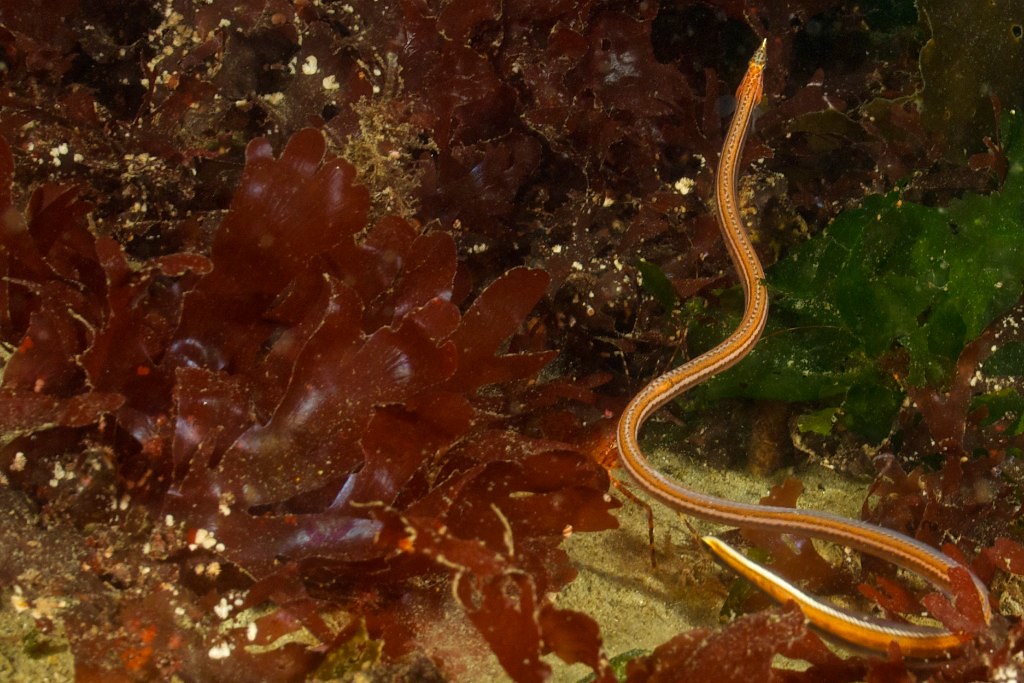
On our first dive, we followed the firehose and had a good time looking around the jungle gym. Heather found an octopus in a small crack. There were huge schools of perch, and the usual giant ling cod. On the swim out, we came across a very unique fish, Ptilichthys goodei, or the Quillfish. This image is not mine, but came from here. The folks at Sea to Sky Scuba helped us identify it. It was very snake-like, and the one we found was orangey yellow, and about a foot long. Very cool!
I got some video. The first clip is the octopus in the crack, and the rest is of the schools of perch.
On our surface interval, we had some small bird visitors. Two small brown birds were very used to people, and almost ate food out of our hands. They were very cute. The granola bar we shared with them was a bit sticky, and the poor birds had a bit of a hard time with it!
Heather got a bit of video too.
On the second dive, we decided to go under the dock. Unfortunately the visibility there was not that good. Most of the dive was brown rock. But we did see some big schools of perch, as well as a very large moon jellyfish. Also, we found a Cresi mask, and reunited it with its owner in the parking lot. Good karma!
I hadn't been out for a scooter dive in a long time, so when Vlad asked me, I was in!
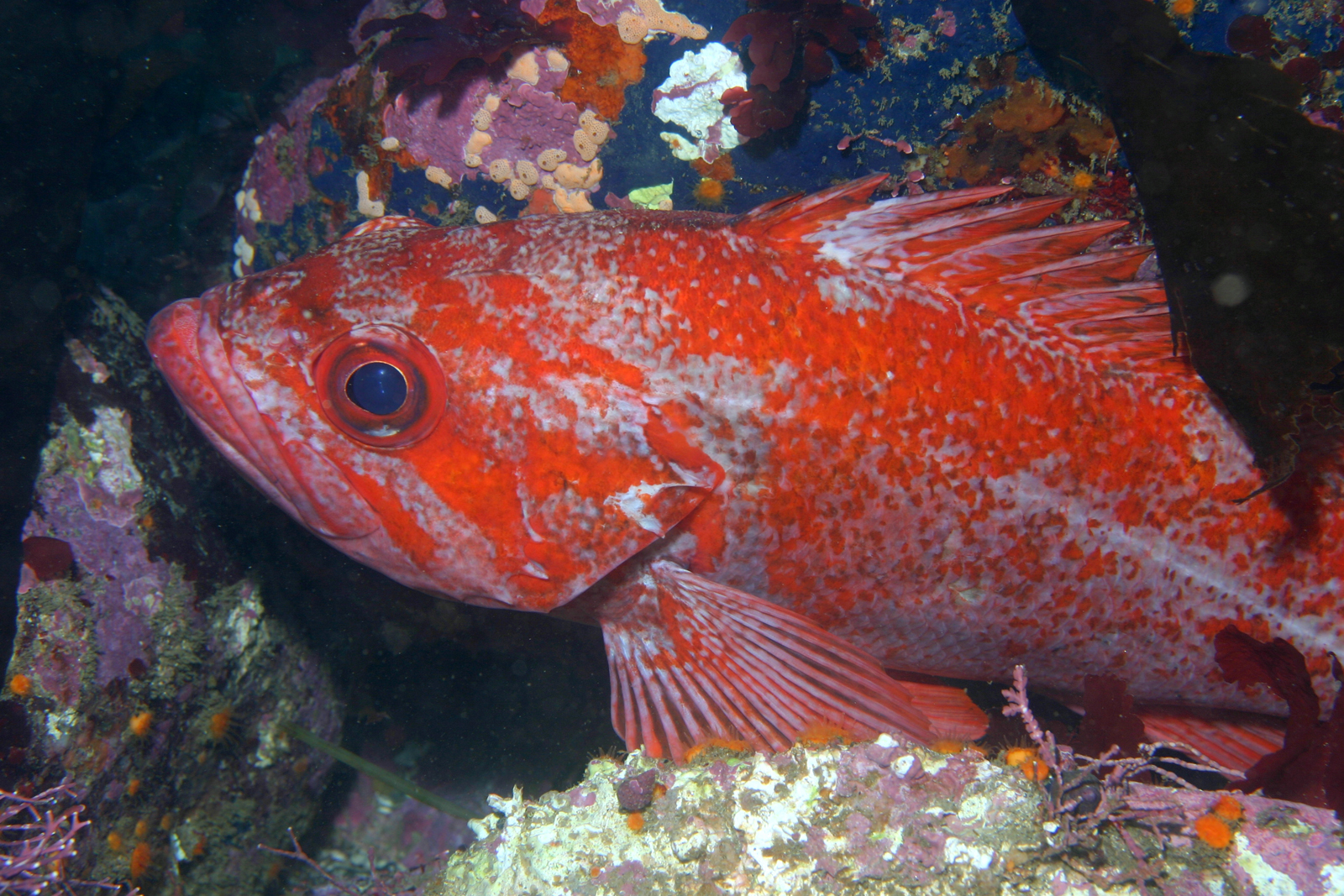
We headed out to Porteau Cove to do a long planned bottom time with some decompression on oxygen. Our total dive time was about 110 minutes. For the dive, we spent most of our time going north along the wall past the Nakaya. The visibility was quite good. Scootering out along the wall show-cased just how interesting the large jagged rocks were. They weren't covered in a lot of life, but that was part of why they were cool. Interspersed in the cracks were small cloud sponges, and many many rockfish. We even came across a lone vermillion rockfish, something you didn't see often.
There were a bunch of old railroad rails, large logs, and a big lion's mane. There were tons of giant white nudibranchs, along with their ribbon egg masses.
On the way back, we stopped past the Nakaya, but the visibility there was awful. Our decompression was done after scootering past the Grant Hall and the fire hose. We amused ourselves by watching the collection of flatfish.
I was getting more used to my new glove system, but on this dive my left glove flooded. I found the problem after. The inner ring that held the glove in place had come loose. So, I would add checking that to my list of pre-dive things.
With the heat wave lately, I started thinking about the cylinders in the back of my truck. Could the heat cause them to fail? How much heat would actually be needed? I decided to find out!
(Without reading further, the summary answer is more than you would ever get on the hottest summer day. To get close, you'd need to heat your cylinder to 150 degrees C).
I apologize for this all
being in Imperial. I was lazy and didn’t find easy Metric examples J If I made any horrible
mistakes, please let me know. I included the original online source material at the end, and extend full credit to them for this information. Vlad also helped by checking my work, and I included his suggestions. Thanks Vlad!
All these calculations assume a known good cylinder, in VIP and hydro, with good burst disks. If you have an unknown cylinder, it may be wise to be more conservative.
Now, on to the math!
Charles Law states (Pressure x Volume)/Temperature is
constant, meaning that pressure rises with temperature to keep their ratio a
constant if the volume remains the same. As a formula, that means:
P1/T1 = P2/T2
Rearranging that, we
can solve for the end-pressure:
P2=P1(T2/T1)
P1 is the initial
fill pressure; let’s say 3500psi for high pressure steel cylinders.
T1 will be the
temperature at which the fill was done. Let's assume a moderate indoor
temperature, say 24 Celcius, or 75 Farenheit, or 535 Rankine. Charles Law uses
Rankine, so don’t forget that part!
T2 will be the
worst-case temperature in your car/trunk, lets' say 60 Celsius, or 140 Fahrenheit
(almost no way in our climate) or 600 Rankine. So let’s do the math!
P2 = 3500(600/535)
P2 = 3925psi
Burst disks are designed to fail at 5000PSI for aluminum, and 5250 for high pressure steel (US source). So even if your cylinder got up to 60 Celsius, you are still far away from that (less than 4000psi).
So what temperature would you need for a burst disk to fail? Let's find out!
5000psi = 3500psi(T2/535)
T2 = 304F or 151C
There is no way your
car will get to 151C, unless it's on fire. Vlad pointed out some interesting facts about how hot your can can get which might surprise you. But even those numbers are not close to 151 degrees.
An approximate rule of thumb: for every 1F temp rise (or drop) inside
a closed container filled with air, you can expect an approximate 5PSI pressure
increase. This is handy to impress your friends when you can predict how much your fill will be reduced when you hit the water!
As with gas-planning, there is no need to guess. Some simple
math arms you with facts based on physical laws! You can’t argue with science J
P.S. something else I learned - We all know to store your tank with very low pressure (100 PSI) to keep water out and material stress low. But if that isn't practical, always store it full. In a house fire, the burst disk may blow from heat combined with pressure if the storage pressure is high. If the tank is half full, the tank will likely give way before the burst disk because the material could be severely weakened by extreme heat, and the pressure rise might never reach the rated burst temperature before catastrophic failure of the tank. This is even more important for Aluminum tanks, they will fail sooner than a steel tank in a fire.
Last year, I had a fantastic opportunity to join Jim Dixon and other GUE-BC members in diving the cave at Nomash River. We planned to go again this year, and I was very excited.
I got quite a few photos throughout the trip. You can see the whole photo album here:
The plan was to go up for two days. For this we spent two weeks planning gear and making preparations (it was a 5 hour drive, and the nearest civilization was 2 hours away). After the trip, we learned a lot. One of the biggest lessons was that you didn't need to bring everything! We definitely brought too much. We had originally had a step in our planning to review and cut out duplicated/unnecessary things, but we ran out of time for that step. Oops. It would definitely be something for next time. Hand sanitizer and more toilet paper were two other good things to add!
Dave and I went over the Friday evening on the last ferry to help get an early start the following morning. The lights of Nanaimo were pretty looking through the ferry doors. Another benefit of diving was declaring Dangerous Goods and being put at the front of the boat!
We met Dennis at Jim's house in Ladysmith, and chatted some before getting to bed. It was always a pleasure to stay at Jim's. The next morning he made eggs and coffee, and we packed up and got moving. We were very excited!
Both vehicles were full to the brim. We had two sets of doubles each, along with extra cylinders for transfilling. Jim, being Cave 2, was able to bring one set and stages, so he got off easier. Another good reason for Cave 2 (among many others!).
The drive up island was great and didn't feel long at all. There was a lot of talk about the trip and diving in general. We stopped briefly in Campbell River for food and supplies, but kept a good pace. After about two hours we turned off to Zeballos and were on the familiar dusty road leading to our destination.
Logging was everywhere, but the scenery was beautiful. We would not be at this cave without logging, so it was a bit of a double-edged sword.
Soon, we had our first look at the Nomash River. We stopped on the bridge and snapped a few pictures. This was Dennis' first trip up, so we wanted to let him see how great the river looked.
Our plan was to haul as much gear as we could down to the cave, make camp, and then go back to do the first dives. Here was our first look at the trail. Last year we had done a lot of work improving the steep slope, and it appeared to have survived the winter for the most part. Even Dave's camo-coloured rope was still there. The joke was that no one could see it, so that was why no bears or squirrels ate it.
Finally the cave! We got a great group picture: Dennis, Jim and Dave.
Dave brought wooden pallets, as it was an idea we had last year. The rocks made it difficult to find flat spaces to gear up on. With some MacGuyver action, we got the pallets down to the river. Dennis had the idea to attach a backplate. Dave's idea was to almost ride the pallet down the hill! I don't have a picture of that, but he came out of the bush with the pallet looking a bit disheveled.
It was pretty hard to describe the path to the cave. It was only a 5 minute walk, but I would liken it to the hill at Whytecliff without the road. Perhaps a short video clip would help give some perspective.
Jim tied off the primary reel to a tree outside the cave entrance. We were serious about a continuous line to the surface! When he dropped the reel into the water, the salt from the ocean and the air in the line caused a huge stream of bubbles. We joked that we had a primary reel failure, and would have to go home. You can just see the bubbles in this picture.
Once all our gear was down at the cave, we took the trip to set up camp (it would also give us a chance to cool down after all that work going up and down the hill). We camped in the same location as last year: a nearby gravel pit. It was a good flat area, and gave us lots of room. It was quite the camp! Dennis and Dave wanted to test out their tents, so we had three. This meant that Jim and I had a tent all to ourselves. Going back to the lesson about "too much stuff" we agreed that one tent would suffice for the number of people we had. The extra tents just really weren't needed. And we would still hear Dave snoring, and Dennis squeaking around on his air mattress!
With camp set up, we were anxious to get in the cave. It didn't take long to get our gas analyzed, gear together and our dive plans reviewed. Here was a good picture of Jim in his happy place.
Did I mention we had a lot of stuff?
There would be no video or photos from the first day of diving. We wanted to focus on assessing the state of the mainline from last year. We would find much of the line still in place, which was great. We ran the primary reel in and tied in. We did learn that the mainline was broken in an important spot. There was a second tunnel, and last year there was an actual T here. Part of that T had been destroyed, and we ended up following part of the mainline into the second tunnel which had a low ceiling and a great deal of sediment. Jim and Greg had explored that tunnel the previous year as well. The second dive on the first day was to retrieve the exploration reel from the silty tunnel, and move to the wider tunnel to the left of that. Once we figured that out, we got in to the bigger, main tunnel and to the drop off area easily. This cave was a perfect Cave 1 dive. It was about 15-20 minutes to the drop off that quickly went down past 30 meters. It gave a 40-45 minute dive, at about a 12 meter average. With double 130s, you had enough gas to do at least 3 dives, and there was plenty to look at. It really was a pretty cave. Quartz sparkled in the walls, pieces of rock jutted up like stegosaurus plates, and sometimes trout would dart in the shadows.
With the first day of diving over, it was good to be done. We were all very happy! Back at camp we thought that bears had moved our tent around, but it was just the wind.
We had a wide variety of dinner ideas. Jim had rice pilaf, Dennis had cheese and meat, Dave made some burgers.
And I made Hobo stew.
The best part of the day was the evening fire. There was no ban in effect, and we were in the middle of a gravel sand pit, so we weren't too worried. The fire helped keep away the mosquitoes (of which there were many, mostly dining on Dennis), but most importantly it promoted excellent conversation and relaxation. Dennis gave some astronomy lessons, and we watched how quickly the stars and moon moved when they were close to the ridge-line.
We slept very well that night. I was up before everyone else, and while I was sitting enjoying the quiet, a humming bird came up and hovered right in front of my face. He didn't stay long, but it was very cool. We had a quick breakfast and got back to diving!
Before we left the camp, I got a photosphere of it. If it worked, you should be able to scroll all around to see the glory of the gravel pit.
Back at the creek, I got a good picture of the morning light creeping along before we started diving.
The second day we had some new plans. First, we would do a documentation dive with video. On the way out, we would retrieve the exploration reel and drop it near the break in the primary line near the T. Then,we would do one more dive to repair the line and retrieve the reel. For the video dive, Dave had brought two 50 watt video lights, but one of them malfunctioned. So instead, Jim took one of the lights, and I teamed up with him as I had Heather's camera setup with two Sola lights. Dave and Dennis would be the first team in, and they would be the subjects. Our plan was to video the whole cave, and then video the drop down the shaft. Here was Jim getting ready to enter the cave.
Once the exploration reel was retrieved, and we finished the video, it was back to the entrance. Dennis and I teamed up again, I dropped off the camera, we recalculated gas, and we headed back in. Jim repaired the primary line, and everything was looking good. Dennis and I had an excellent dive, going through some of the swim-throughs and pointing our lights at the ceiling to reflect the light off of the pools of air there to create a disco effect in front of us. I didn't take many photos, but did get a picture of Dennis here. It kind of looked like he was jumping out of the dark.
Here is a look at what it was like to ext the cave.
There was a lot of video to go through, and it would take a while to go through. So I put together a teaser video of the short sequence of the descent down the drop-off portion of the cave. The bubbles were very cool. In the video is a quick piece of surfacing as well. The longer video would have to come later.
Here is the final cut video, with additional footage. The clips are not in chronological sequence as I moved them around to make a better video. There is one diver with a stage in the video (Jim Dixon) who was Cave 2 trained. Apart from that, the dive was Cave 1 limits.
The weekend ended all too soon. With the diving done, we had all the gear back up the hill, and the camp broken down quite quickly. It was a bit of a challenge packing the truck, but Dave was a pretty good Tetris player.
Soon we were back on the highway.
And back to civilization for some well-deserved celebration! A fantastic trip!