Monday, November 6, 2017

Florida Cave Diving 22-26/10/2017

I attended the GUE Conference in Florida for the first time this year. I'll lead with my video compilation of the diving portion, just in case you want to stop here!


Like many others I arrived a few days early to do some cave diving. Jim Dixon and Joakim Hjelm also arrived along with me. I had never dove caves in Florida, and was quite excited. Florida was pretty much the "de facto" home of cave diving, producing such explorers like Sheck Exley, and leading to the formation of GUE itself.

After a long day and night of flying and then driving, we arrived in High Springs. Google maps took us on some interesting routes! Meredith Tanquay helped put us up. This would be our home for over a week.


The back had a nice barbecue and fire pit. Pretty sweet!


Monday was the first day of diving. However on the night we arrived, we had a funny experience with ghosts in the TV. At about 6:30 am the TV came on super loud. Jim and I thought that our room-mates had decided to turn it on, and had been somewhat inconsiderate leaving it on when they left. Later that morning, after we turned the TV off, it came on by itself! We found out from Rob and Randy that they had not turned the TV on at all. Florida Gremlins I guess, and a funny story. We had been too tired to get up and say anything. Needless to say, I unplugged the TV for the rest of the trip. Who needed TV when there was so much else to do!

On our first day of diving in Florida, we checked in with Extreme Exposure, picked up cylinders and went for a checkout dive at Wes Skiles Park. It was an hour drive and there were several torrential downpours on the way. We all hoped it would not continue, and there were a few comments about possible lightning. Could you get hit by lightning in an underwater cave? It seemed highly unlikely...

At Wes Skiles Park, we paid our fee and parked. Then I got to check off two things from my bucket list: first dive in a Florida cave, and meeting Jarrod Jablonski (who just happened to be there teaching a class). Mark Messersmith, one of my cave instructors was there too, as was Alex Adolfi and some Seattle folks doing their Cave 1. It was a great reunion. Here was Jo, Alex, Jim and Francesco, happy to see each other.


We had also met German from Bonaire (aka Mister G). Since he was Cave 1 like me, I ended up diving for the rest of the week with him. Here were two pictures, Jim, Jo and Mister G and myself. Great photos!


The dive site was not what I expected. Dark tannic water and carpets of duck weed. Later we realized that we actually dove Orange Grove instead of our planned Peacock cave. Whoops. There were even signs everywhere which I guess we missed somehow. It looked like I was going to be diving in a pond back in Thunder Bay, Ontario. It was not at all like the crystal waters I had expected (however, that would soon change).


The weather all week was perfect. It wasn't too hot at all (in fact many days it was quite cool). But Jim and Jo still did take the opportunity to cool off.


Orange Grove was very interesting. I had never dove in such dark tannic water before. It was a pretty vertical descent in, dark, and certainly challenging but lots of fun. Once inside, the tannic water disappeared and was replaced with crystal clear water. The cave was beautiful with little flow. Now we were talking!

Once out of the water (despite our best efforts) our gear was covered in duckweed. I was not expecting to have to rinse off after diving in fresh water!


After fills and some food, we got orientated to a supermarket, and got a good nights sleep. Tuesday dawned misty and quite cool. I was glad I brought my jacket. Across from us was a field full of cows.


We hooked up with Mister G again and went back to Wes Skiles Park to dive the correct cave, Peacock. Heissan Chak from Ontario joined our Cave 1 team as well. After diving with us, he thought Mister G and I had been diving together for years, yet we'd only met the other day. It was a true testament to standardization and robust training. You could get into the water with any GUE diver and expect to work well. And have fun!


This was my first encounter with an alligator warning sign.


And there was a monument to Sheck Exley, Cave Diver #1. He did a lot of his diving at Peacock.


Jim and Jo, ready to get diving!


We did two dives on the two lines of Peacock. Olsen Sink line was large and quite open, but Peanut Tunnel was my favorite. There was a very cool squashed section that was fun to navigate. The entry was more like what I had expected. Clear water, little flow, and a quick run to either line.


There was a worker in the pool putting in a water level measuring device for SAVE (Springs and Aquifer Volunteer Efforts). On our second dive, we encountered quite a lot of silt rolling down from the entrance as a result of this work. It was brief, but unexpected. I don't think I'd ever seen a silt cloud like it before. We spent some time talking to the guy, it was very informative.


After his dive, Jo wanted to do a weight check. With the heavy steel double cylinders we were using, along with few undergarments, this made us quite heavy and he wanted to check by how much. I got a pretty cool picture of him draining down his cylinders. Jim and I both agreed that more lofty undergarments were needed next time. Others had recommended a 200 gram thinsulate garment, which just seemed overkill to me. But it really looked like you needed the extra "loft". I was using a base layer along with fleece booties and a thinsulate vest, along with neutral fins and an aluminum back-plate. I figured I was still probably 5 pounds negative. I certainly was glad I didn't bring a steel plate!


Speaking of doubles, I had to take a picture of the huge 20 liter double cylinders at Extreme Exposure. I never thought such things existed. They weren't all that much heavier than a set of 16 liter doubles, but they still seemed massive.


Wednesday we went to Madison Blue. Getting there was a bit of a challenge, as I made a wrong turn (Google is not always your friend!). Madison Blue was a higher flow cave and it was more of a challenge to get inside. You can see the water flow from this picture.


You could see how it got its name from this picture! Much different from Orange Grove.


We had two dive teams: Kees, Jim and Jo, and Nick, Mister G and myself. When we got in the water and started fining into the current looking for the mainline we found it right there. But, we had already started running our primary line so we just finished tying in with that. Jim made a better call just skipping running a primary since the mainline started in the daylight zone. It paid to be observant. Madison Blue sure didn't disappoint, it was a very pretty cave. The flow wasn't too bad either, if you followed some of the tips to stay up and out of it.

After the dive, Nick and I did some skills. We ran a line and made a T intersection for fun. One of the exiting dive teams got a bit confused by what we were doing, thinking we were "lost". Once we explained with a few hand signals that we were practicing, all was well. We finished a very successful day of diving with a fist bump.


We found time to visit the Halcyon gear manufacturing facility and met Orie, who showed us around a bit. Jo and Kees needed to pick up some demo gear, but I couldn't resist snapping a picture of them leaving the candy store like bandits.


Thursday was the big one: Ginnie Springs and true high flow. As expected, there were several dive teams there, as it was a very popular spot. There weren't just divers, and many people swam in the crystal waters and enjoyed camping, snorkeling and paddling.


The morning was gorgeous, with a thin mist on the Santa Fe River.


You could see the difference in the dark tannic waters of the Santa Fe on the right, and the crystal blue waters of Ginnie Springs to the left.


People weren't the only ones enjoying the park. Many squirrels were looking for hand outs...

 
 Jo, Jim, and Kees planned a Cave 2 dive. Poor Kees stayed right in the flow and got a headache from all the exertion. Jim asked him why he didn't take the suggestions of getting up near the ceiling, and he said with all the information overload he just plain forgot. Poor Kees. They looked pretty happy after the dive though!


Alex Adolfi and crew were there too, doing their first set of official cave 1 dives after passing their course.


Mister G, Nick and I did two dives into the Eye, then two into the Ear. The Eye entry was not as bad as I thought. The Ear was a challenge. All the tips people told me did not truly prepare me for how different high flow was. Going in relatively vertical, fighting the flow, and making line tie offs was tough to do. There were a lot of lines in already making it even more complicated. I did finally manage to get a tie-in to the main line. Our dive lasted only 15 minutes as all my gas had been spent putting in the line! 50 bar had gone by very quickly. But I took heart in that this was pretty much normal for a first attempt. The dark tannic water of the Santa Fe River made for a surreal entry as well. Here was a different dive team entering the Ear.


And another shot looking down into the Ear.


I didn't get any images from inside the Ear out bit I did get outside in. Randy got a classic image from inside looking up and out.


On the way out of the Ear, another team of five divers came in and it was a bit of a mess. However, we waited off to the side while they got cleaned up and we got past them. Coming up out of the Ear was interesting too. I finally understood what Jim was saying about the log at 6 meters. Resting on top of that log out of the flow was perfect.

After an initial adjustment phase to the flow, Ginnie was a lot of fun. With all the tips I found it intuitive to look for the areas protected from flow, and move hand over hand when not. The hand over hand part was a lot like underwater rock climbing.

Here was a good group picture of many of the GUE divers there.


And a really cool picture looking down into the Little Devil. It was very tight and from what I understood: side-mount territory.


In the shallows, schools of fish teemed, and very cool river plants abounded. It really was magical.


Ginnie Springs pretty much wrapped up my diving adventures. For the rest of the trip, I attended the GUE Conference for 2017. I'll sum up all that in a separate article. Until then!

Sunday, October 1, 2017

GUE-BC Mini Wreck Fest 23-24/09/2017

This year GUE-BC held a "mini" Wreck Fest in the Vancouver area as opposed to the Wreck Fest that had been held on Vancouver Island for the past few years. The idea was to get more cross-pollination happening, and get people onto the newest wreck, the HMCS Annapolis as well as the unique Sponge Bioherm. As always, we used the excellent Sea Dragon Charters, Captain Kevin and Jan!

Day one was a perfect. The full roster was Jim, Liz, Nick, Francois, Michael Shapiro, Andrea, Zach, Myra, Vlad and myself. We had a lot of gear to get onboard, and Vlad took advantage of the carts.


This picture was only a sample of what we brought on board. We were lucky to have the Topline, it could really fit a lot. Normally you could have at least 18-20 people, so we had room with our 10 even with scooters, extra sets of doubles, decompression gas, and stages.


You can't get away without a bunch of happy diver pictures!


The first dive was on the sponge bioherm close to Halkett Wall. It was one of the few sponge reefs that could be reached by scuba (the others being 400+ meters). It was affectionately known as "Spongebob" and was only dive-able at certain times due to tide, current and weather. There was no place to tie up, so it was a live boat drop and recovery. Also, it was in the middle of Howe Sound so boat traffic could be a real issue, especially when dive teams had decompression obligations. Today was perfect though. There was surface current but it was not bad at all, and it was easy to stay in place on the ascent portion.

There were three technical dive teams and one recreational. Here was a great photo from the rec-team courtesy of Myra. It really shows the size and beauty of these sponges.


I was diving with Francoise as part of the technical teams. I forgot just how much of the bioherm was accessible at recreational depths. When we reached the bottom we were around 30 meters, and the sponge mound beside us kept going up to at least 25 or even 21 meters. It actually took some effort to find our deeper depth! On my next dive, I would remember not to go north east around the mound. That led to a shallower saddle area of mud. For a tech dive, it was much better to circle around to the north west side. However, this would only work if you are dropped on the south end of the mound. On all my previous dives, this was where we were dropped. It would be interesting sometime in the future to get to the north portion and check that out too.

I was diving with Francoise, and once we were at our target depth of 45 meters, it was magic. I had forgotten just how different the sponges were on the bioherms. Many of them looked like melted wax candles. And they were indeed huge! Francoise had his camera and got a great photo of me over one of the sponges.


Unfortunately even in this remote place, there was evidence of humans. A big reason to study and document the sponge reefs was to document the impact on an environment that few ever see, let alone know about. Any area that was not directly visible could easily be affected by ignorance. A case in point was this derelict crab trap sitting on the south west side of the bioherm at about 42 meters. Vlad and Nick reported that a line ran from it to another trap further down. These crab traps were a good target for a ghost-fishing cleanup exercise in the future.


On a lighter note, I spotted several Peltodoris lentiginosa or freckled sea lemons. They were at least as big as my hand, and were cool in that they were one of the few things that actually ate glass sponges. In the linked article, I learned that "this was the first documented instance of animals feeding on glass sponges outside of Antarctic waters". Pretty cool for our back yard! Here was a picture of one eating its lunch.


The sponge reef was home to wide array of other life, such as copper and quillback rockfish, along with several juvenile yellow-eye rockfish, distinctive with their horizontal white stripes. I submitted the rockfish I counted to the Vancouver Aquarium for this year's Rockfish Abundance Survey.

Francoise and I met Nick and Vlad during the dive, and here was a good picture of just how bright your lights needed to be to get some of those stunning images. This was from Vlad's perspective:


And this was from Francoise's perspective. It was funny that they took pictures at the same time!


Pretty soon our bottom time was over, and it was time to do our deco. I found the shot line at the end of our dive, so our deco was even easier. We still deployed an SMB as part of our dive plan to notify the boat that we started our ascent. Francoise didn't quite get enough air inside, so ours spent more time below the surface than on. Vlad got this picture of Nick to show what the 30 or so minutes of deco looked like. I was quite surprised that at 6 meters the visibility was so cloudy.


Back on the boat, we had a nice relaxing surface interval. Vlad and Nick decided they needed more in-water time!


The Coast Guard hovercraft was also at the HMCS Annapolis doing some diving.


For the Annapolis dives, we had recreational dives, scooter dives, and penetration dives. There was a lot going on! I was scootering with Vlad and Nick, and we had an excellent time. We visited Project Baseline Station B first. Vlad replaced some of the rusting metal bits with zip-ties, and I did a quick visibility measurement. Station B was away from the ship, and it was really silty in that area. It was a real challenge. Vlad got a picture of Nick adjusting the station some. In the top of the frame was the temperature sensor that Vlad and I had deployed a week before. Unfortunately I had forgotten the float that had come loose the last time, so we were not able to repair that this time.


We spent the rest of the dive just playing around the wreck. We were nipping up and down the breeze-ways, through the swim-throughs, and in and out of the mortar bays. Francoise snapped a great picture of Jim entering the wreck and us scootering above.


The growth of life on the Annapolis just continued to increase. In the last year or so the plumose anemones had really gotten both large and numerous. They were also starting to establish inside the wreck as well. Here, Francoise got another good picture of Jim and the inside.


Outside was impressive too. I snapped a picture of Vlad lining up for a shot of some anemones at one of the cut-outs.


Myra got another great picture of the pretty plumose anemones near the bow. Truffula trees from Doctor Seuss anyone?


Too soon, it was back on board and heading for home. Kevin and Jan had a snorkel tour going out, so we had to get back pretty fast. Once we had everything packed up, most of us got together for a bite to eat in Horseshoe Bay. It was a perfect end to a perfect day; good friends and good food.

But, we weren't done yet! On the following Sunday, we had dives set up for Whytecliff Park. Unfortunately, only Jim, Francoise, Vlad, myself and Dennis were able to attend. Still, it was another great day for diving.


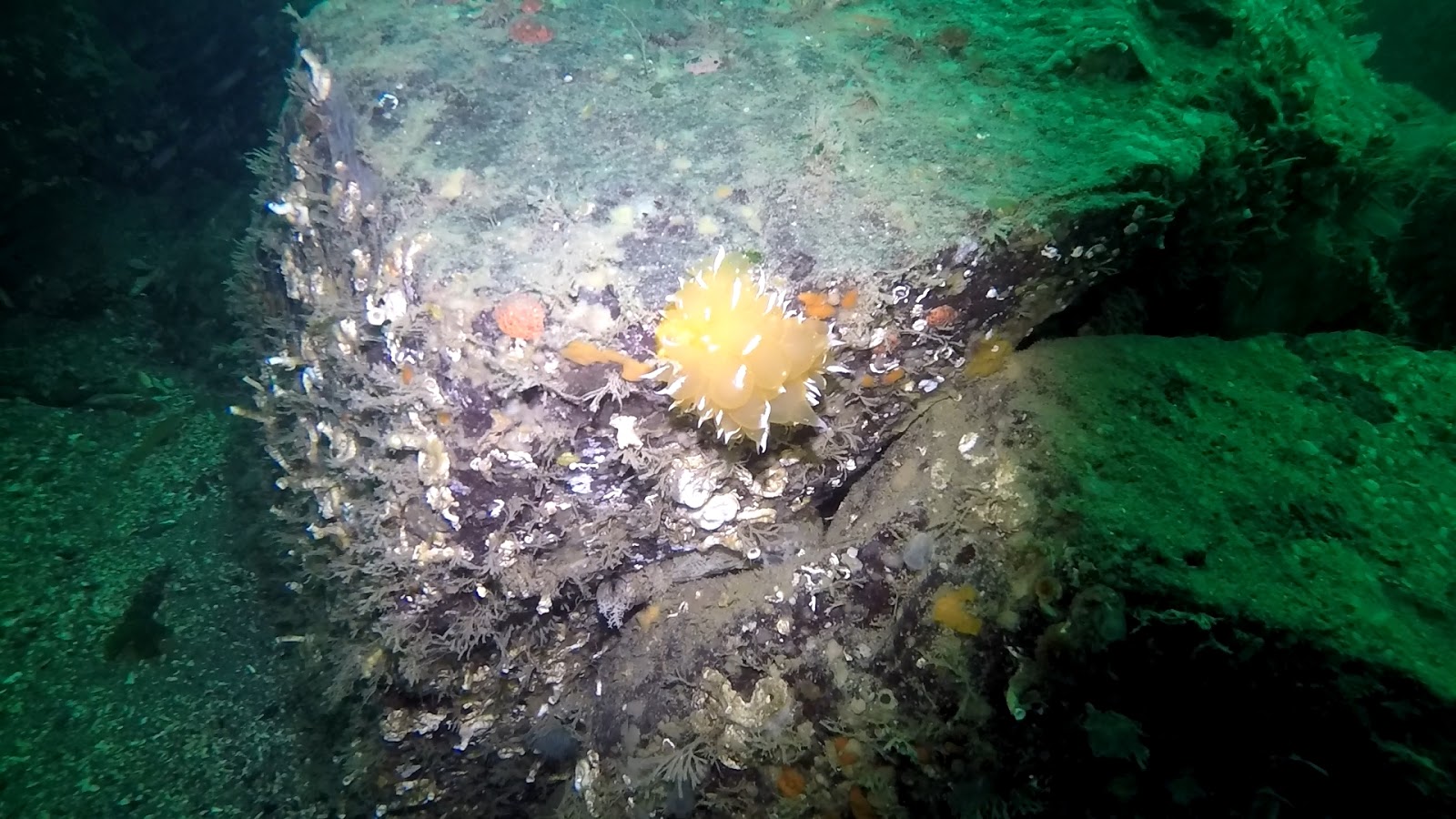
Vlad and I did a scooter dive out past the Cut, and also ended up meeting Dennis, Jim and Francoise at the Plumose gardens on the way back. Vlad and I went to try and find the strawberry anemone patch we had discovered the previous Wednesday, but were unsuccessful. We sure saw a lot of other great things though. The highlights were huge patches of Zoanthids, golden dironas, a very photogenic decorated warbonnet, a puget sound king crab, and huge schools of perch and rockfish.


I was most impressed with the number of nudibranchs. On the previous Wednesday, I didn't see any. On this dive, I saw over ten. We had a deeper dive profile on the Wednesday dive, so that could have been a factor. If so, the nudibranch activity was centered around 15 to 20 meters.

While scootering along, we noted a really big tree lying perpendicular on one of the rock walls. It was a bit eerie, like a ghost tree.


We also found the remains of a fish, but were not sure what kind. I would have to ask the Aquarium for some help on that question.


Francoise got some excellent pictures of their dive. Here was Dennis checking out a cloud sponge near the Cut, with great trim.


And another of Dennis and Jim checking out the Plumose gardens.


At the end of the dive, I snuck up behind Dennis, Jim and Francoise and got a picture of the happy divers.


It had been a lot of work to organize, but the weekend went off without a hitch. Thank you to everyone who came and made it a success!

Last but not least, here was the video compilation that I put together.


Friday, September 22, 2017

Whytecliff Park 20/09/2017

What could be better than an evening dive for Whytecliff Wednesdays? The answer, not much!

After the previous weekend beach cleanup organized by Khrista, it was the perfect time to enjoy the newly cleaned surroundings. There were quite a few folks out, probably close to 15 I would say. An excellent turnout.

I was diving with Vlad Chernavsky, and our plan was to do ascent drills and skills, then go on a fun scooter dive. The evening was perfect, and the tide was at high slack. When we brought our scooters down to the beach, John Nunes joked that he was going to throw them back in the water. This was in response to my staged joke picture from the beach cleanup where I pretended to put a side-mount tank into my garbage bag. All in good fun of course!


Our dive couldn't have gone better. We scootered out to 30 meters, deployed an SMB, did two ascent drills, mid-water valve drills, and cleaned up in record time. The visibility was pretty good too, which was a big bonus.

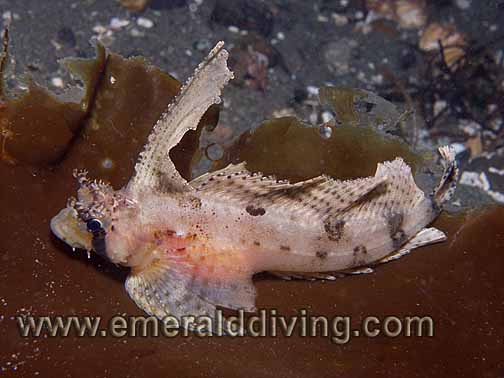
We scootered over towards the plumose garden from mid-bay. On the way, we found some very interesting cartilaginous skeletal remains. It looked like some kind of skate. We also came across some of the largest sailfin sculpins I'd ever seen. I did not take any pictures, but here was good example.


We passed by the plumose gardens and headed North. There were hundreds of juvenile yellowtail rockfish schooling. I'd never seen so many. We passed several groups of divers on our way. Vlad spotted a juvenile black rockfish in a crack which was very unusual.

When we turned the dive, we ascended to about 15 meters and came across a large patch of strawberry anemones. They looked similar to this.


We made a note to come back along that way and check out this patch again. It was not something that you saw often at Whytecliff, and a worthwhile thing to see again.

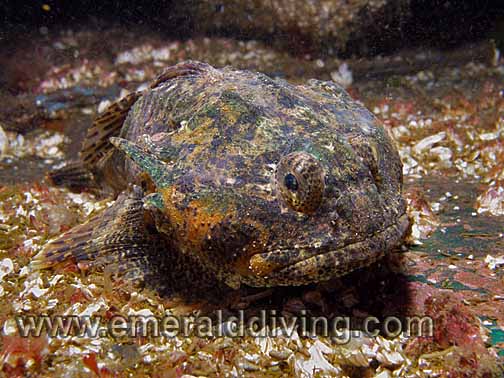
On the way back, we came across a well camouflaged buffalo sculpin, hiding in plain sight on the sand. Again, no picture, but similar to this.


Back at the plumose gardens, we spent some time investigating a "deflated" giant plumose anemone. It looked like it had just fallen over. Neither of us had seen something like this before. The plumose anemones would retreat back into themselves, but I had never seen them fallen over like this. Previously there were reports of plumose anemones "missing", and just leaving behind black circles where they were attached. We didn't see any of the black circles though. It was very odd.

We also saw only two nudibranchs, a giant white dorid and a white-lined dirona. It must have been in between nudibranch spawning seasons or something.

On the way back, we passed several more groups of divers. It was certainly a busy night!

On our way back into the bay, Vlad saw a pink sea star and noted some lesions on its central disk. Hopefully the sea star wasting disease wasn't spreading further. There were still no sign of the sunflower stars that were so common at Whytecliff. They had been completely wiped out, and were not seeming to recover at all.

All in all a very successful dive, and we saw and learned lots!

Sunday, September 17, 2017

HMCS Annapolis Project Baseline 10/09/2017

It had been a long time since I had been out to the Annapolis, so Vlad and I decided to get our scooters and have some fun while doing some work for Project Baseline Halkett Bay.

It couldn't have been a better day with Sea Dragon Charters. It was a very full boat though, and I'm glad that we didn't have anyone else along with as much gear as we had. There were at least 15 divers on board.

Once out at the Annapolis, we got into the water first to clear the deck. We also decided and planned a long two hour dive instead of coming back to the boat. We figured this would be easier with the amount of gear we had. Our first stop was Station B, away from the ship. The line that had been run the previous year was still in place, but it was covered in brown gunk and difficult to see. Once at Station B, we found the float and Secchi Disk in disarray. Vlad touched the float and it broke away and took off to the surface. The metal clasp that had been used had just rusted straight through. We realized that we'd have to replace all that with plastic zip ties later.


Vlad deployed and attached his temperature sensor, and also snapped a great picture of me.

Next we scootered around the ship. We checked out the stern, where there seemed to be a million shrimp. We also noticed ripples in the hull metal from the sinking. It seemed to stand out more, or maybe I'd missed it on previous dives. Vlad commented later that the area around the props seemed more excavated, maybe due to water action. We scootered through the swim throughs, down the breeze-ways, checked out the mortar bay, helicopter bay, and just about everywhere. With scooters it was very easy to see everything several times. On the bow, the railing seemed damaged on the port side, probably by getting hooked by someone's anchor. We actually started to run out of things to do!

We visited Station A above the bridge and took visibility readings there (as we had at Station B). I headed in to the bridge to try and do some photos, but none of those turned out. It was still fun!


In terms of life, there were even more shrimp and green urchins. I counted several copper and quillback rockfish, and submitted those to the Vancouver Aquarium Rockfish Abundance Survey. In the helicopter bay, there were a large abundance of scallops. The plumose anemones were really growing, and were everywhere. They were especially starting to grow from the ceilings in many areas.

Back on the boat, Nick from OceanQuest dive center was out on his sailboat, and actually recovered the float from Station B. Quite a lucky find! We would have to replace that on the next dive.


I put together a short video if you would like to see more:


Saturday, September 2, 2017

Porteau Cove 30/08/2017

After seeing Jim, Dennis and Jo scootering in the Nomash Cave, I figured it had been too long since I'd been out for a scooter dive to. Vlad and I got our gear and headed out to Porteau Cove for a Wednesday night dive. It was a perfect evening. The heat wave had subsided for a bit, and it even rained some during the day.


Our plan was for an hour and a half run time with some decompression on oxygen. Visibility was a challenge at the start and end of the dive. We were basically in touch contact while we scootered out to the Nakaya. It was still fun, doing it all by compass but a bit nerve wracking because we almost ran into the pipe reef on the way!

Once we got below 30 feet / 9 meters visibility improved. The water temperature also plummeted to about 9 degrees as we passed through a distinct thermocline. There was also a huge swarm of moon jellies that made it like a doge-em video game. Unfortunately at least one got sucked through my prop despite my best efforts. Sorry moon-jelly!

We missed the Nakaya on the way out due to the challenging vis, and aimed instead for the rock wall. Half our dive was planned at 100 feet / 30 meters, and the visibility was around 20-30 feet which was quite good. I did some rockfish counting for the Rockfish Abundance Survey and just generally enjoyed the dive. The boulders and rocks were always interesting, with cloud sponges and anemones here and there. There were several large ling cod, and a few white nudibranchs. At the end of the scooter Vlad deployed his GPS on a string and got a fix for how far we went.


On the way back was the best part. We came across five Dogfish sharks at various points. Several of them were at least 4 feet long and very cool. I had not seen so many Dogfish at once in a long time. This was not one of my pictures, but came from Wikipedia.


We also came across a wrecked car chassis on the bottom. We had come across similar wrecks before, but this time Vlad took a GPS reading so we could reference where it was on a map.


We successfully found the Nakaya on our way back. It was continuing to deteriorate and with the bad vis and an ever increasing dive-time we needed to keep going. We headed past the Grant Hall, and the vis just kept getting worse. We got onto the fire hose then headed in to the bay. At 6 meters we started our deco and tried to see anything in the soup. There was one last Dogfish surprisingly, as well as about a million Pacific Snake Pricklebacks. It was fun and challenging to do some deco in such conditions. Finally we surfaced and were not far from the stairs. The current was quite impressive and we had to use our scooters to get us back.

All in all a very fun and successful dive!