Monday, May 18, 2015

GUE-BC Project Baseline Britannia Beach 16/05/2015

Josh organized a GUE-BC Project Baseline Britannia Beach dive to collect some data. From the Baseline website summary "Project Baseline empowers passionate citizens to observe and record change within the world’s aquatic environments in a way that fosters public awareness and supports political action". Data gathering projects were hard to maintain, with high initial enthusiasm, but getting regular visits were tough. Invariably it would be the same people going out, which got old quick even with high levels of enthusiasm and commitment. Josh did a great job driving it, but always needed more help.

The data gathering aspect of Project Baseline was designed to be as easy as possible. At a station, only depth, temperature, and visibility had to be recorded. A diver just needed to illuminate the visibility plaque, back away, and at the point where the two outside bars blurred together, record the distance. This was a picture of what the visibility plaque looked like. You could see that the outer two bars were still visible.


You did need some way to record the distance, but you didn't need to bring a tape measure. A piece of line with a knot tied in it at that point, then measured later would do. Or a line with regular intervals marked on it could be used.

Part of our goal on this dive was to make finding the stations easier. There were only two stations, but there was no guarantee that everyone could find both. The first station at the stern of the Ready was relatively easy to find. Josh's plan was to run a line from the bow of the Ready, along the bottom to the second station at the Cape Swain. 

We met up at the parking lot at the Galileo Coffee company. John took a group picture. From left to right: Dave,  Dennis, Nick, Anton, Alex, Evan, John and Josh.


It was low tide when we did the dive, and the plan was to swim to the first dock piling and drop on the Ready. John got a picture of the beach. It really was low tide!


There were a few problems at the start of the dive, with a leaky o-ring on an LPI, and a flooded scooter. Unfortunately this meant that the scooter team had to leave them behind, but the o-ring was fixed easily. Crossing the road was a bit of a challenge too, as there was a huge amount of traffic going up to Whistler for the long weekend. Frogger, anyone?


Alex and I dropped on the Ready, and in less than 3 meters there it was. Visibility was better than it had been on the last dive we did at Britannia. When descending on the Ready you needed to be quite careful, as the wreck is a real wreck. If the visibility was bad, there was a good chance of you landing on broken bits of the wreck. There were quite a few sharp edges and bits.

Alex and I found the first station at the stern of the Ready and took the first readings. The visibility was pretty good, I measured it to be 4.9 meters. We found the wheel of the "mystery wreck" located beside the Ready.


We came across a lot of perch, ling cod and dungeness crabs. There were no nudibranchs though, which was odd.


We found the line that the other teams laid, and followed that to the second station. The start of the line was tied as planned to the bow of the Ready.


Since the bottom didn't offer much to tie off to, tent pegs were used. We joked about the pegs, as we didn't know if they would float away. Josh discovered that the pegs he bought at Canadian Tire were neutral though. Good to know for the future! Dave laid the line, and did a good job.


The second station was shallower, and the visibility was definitely worse there. I took a picture of Alex beside it.


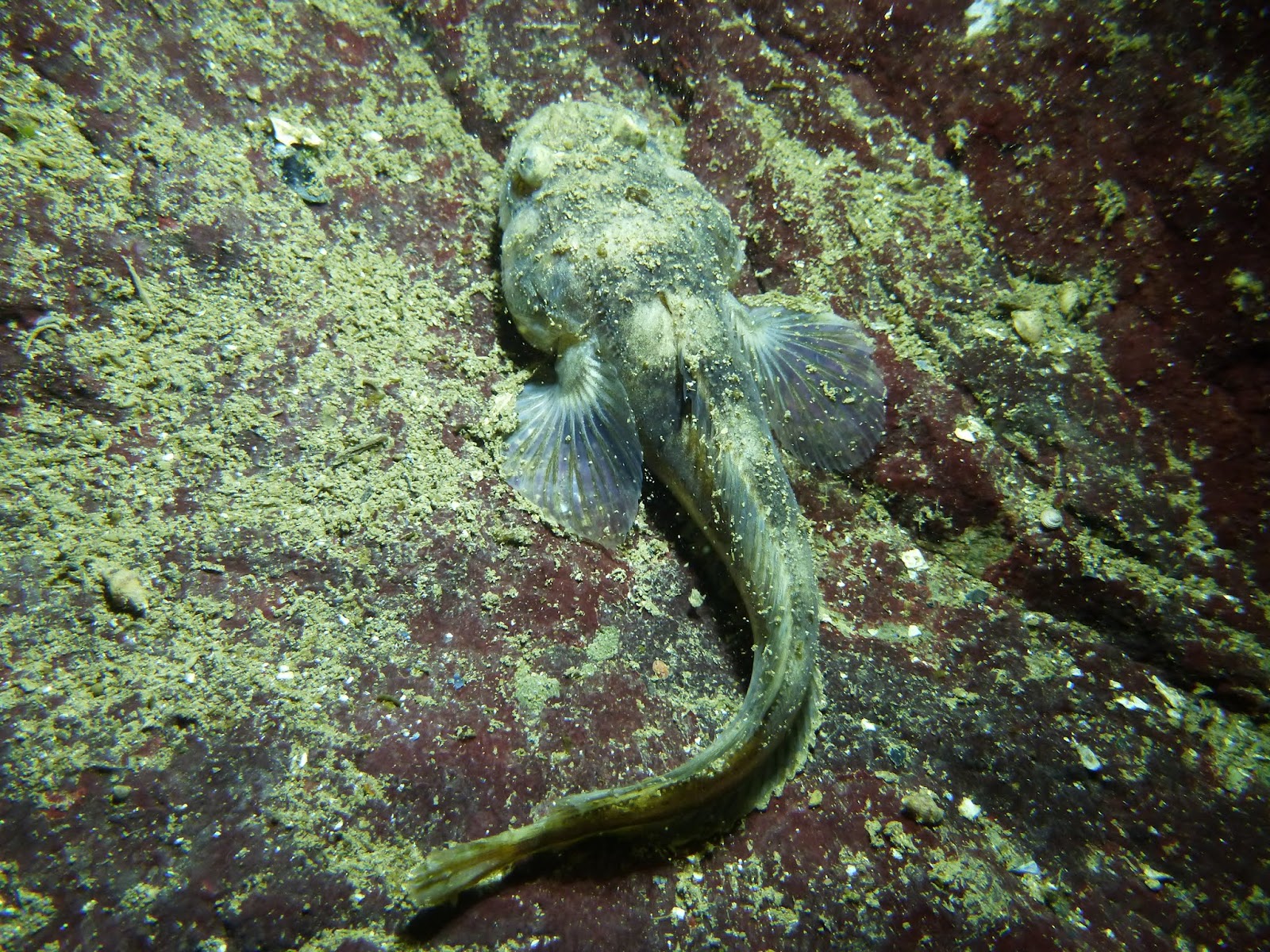
I took the measurement as 2.1 meters. We met up with Nick and Evan on the way. At the base of the station were two interesting sculpins.


We followed the line back to the Ready, and discovered half of an empty white egg shell. It was about fist-sized, so it wasn't a small bird. It probably was a Canada goose egg shell. At the Ready, we did some skills. Dave did some bottle switches, and Alex and I did some valve drills and S-drills. I got an interesting picture of one of the port-holes, totally encrusted.


I got another neat picture of a shrimp hanging out on the side of the wreck.


 Finally we just followed the bottom contour up and finished the dive. Here is the video I got from the dive.


Tuesday, April 14, 2015

HMCS Annapolis First Dive 12/04/2015

Our first dive on the HMCS Annapolis!

We didn't think we'd be diving it so soon. I had been sure that there would be too much competition for spots in the first few weeks. Fortunately, Liz Tribe secured the Topline for Sunday, and Heather and I lucked in to two spots.

It was a very full boat, with 18 divers. The Topline sure could pack them on! Captain Chris and Rachel were our excellent crew. Rachel snapped this group picture of us at the end of the day. We had divers from the Island, scooters, doubles, singles, rebreathers, you name it!


Weather was amazing that day too. I had thought it was going to be cold and rainy, but it turned out to be sunny and relatively warm. We also had on board a diver (Dave Tomblin) who had served on the Annapolis, and they were so kind as to upload this old picture of the Annapolis from its sailing days.


There was a second boat trip out that afternoon, so we were under a clock. Fortunately, we had a great group and everything went smoothly. On arriving in Halkett Bay, we tied up on the stern line, and were soon diving.

I was very impressed by the stern descent line. A large square aluminium frame had been installed at 6 meters (20 feet) allowing divers a safe platform to do their safety stops or deco. Very nice! The stern line was the deepest of the three lines at about 80 feet. The line itself was quite loose, so it was a challenge to follow it. It also went at quite a shallow angle, meaning that it was not directly over the ship itself. One dive team decided to drop straight down, and ended up missing the wreck. So if you were descending on the stern, just keep following the line, it was your best bet to get there eventually! The stern deck came out of the darkness, and we got our first look at the new wreck. It was very impressive. Visibility was not bad, maybe 20 feet. Even though the sun was out, the surface layer made this pretty much a night dive. Still, it was great. We moved towards amidships, and found several displays of stainless steel rockfish had been installed. We noticed one of the other dive teams had written their names in the silt that had already started to coat the wreck. There was no life yet, but that would come. We were surprised to find a seagull carcass, as well as a mesh bag containing a brand new ball cap and hockey jersey. 

On the second dive, we tied up on the amidships line. Nick unfortunately lost a fin off the boat, and tried to recover it on the second dive, but had no luck (If you find an XXL Jetfin, let me or Nick  Bowman know). Our second dive was a lot of fun too. We spent time looking in the windows of the bridge, checking out a few swim throughs, and just having a good dive.

It was a challenge to get good video with the dark conditions, but Heather got some good bits. Here are the highlights. Enjoy!


Update: Sea Dragon Charters put together a very good compilation video of pre-and-post sinking.


Sunday, April 5, 2015

HMCS Annapolis Sinking 04/04/2015

It finally happened. The HMCS Annapolis sank almost perfectly on Saturday, and Heather and I were there to see it. The running joke was that we wanted to see it actually sink with our own eyes. There had been so many delays, so many promises and so many years, it was amazing to see it actually happening. I had been glad to volunteer some time to help in the long preparation process.

If you'd like to skip to some of the good stuff right away there were two good online sources of coverage of the event.

CTV News report of the sinking.

CTV News aerial view of the entire sinking.

ARSBC Streamed video of the event.

You could actually see the Annapolis from the Sea to Sky highway when it had been towed to its soon-to-be permanent home on Tuesday. Heather and I had driven up to Squamish on Friday and we noticed it. I'm sure that many other people had too! Heather took a picture, but it was a bit far away, and we decided not to traipse through someone's back yard to get a better look. It sure did look big. The photo didn't do it justice.


Sea Dragon Charters coordinated several boats to go out and view the sinking on Saturday. There were t-shirts, snacks, and a post-sinking barbecue. With the long weekend we went up a bit earlier to find parking. The weather was not bad; overcast and a bit rainy. We really didn't care so long as it would allow the sinking. We were in the boat Kinbasket Queen.

 Helping coordinate was Liz Tribe from the Island. She handed out t-shirts and made sure everyone was present. Thanks Liz! A photo of her in action courtesy of Vlad.


Our boat held over a dozen people, and this was a photo of the folks that I knew best. From left to right, Lindsay (Dennis got cut out of the picture), Josh, Dirk, Evan, Vlad and John.


Then Doug and me. Heather was taking the photo.


Once on board and sorted out, we were underway. It was a bit of a dismal ride out, and we hoped that it wouldn't be like this the whole day. Here was one of our first looks at the Annapolis. You could see some raindrops in the photo. Fortunately the weather almost completely cleared up for the sinking itself.


We got out to Halkett Bay around 930, and then heard that the sinking was probably around 1245. It was hurry up and wait time. A chain of logs had been set up across Halkett Bay to separate the on-lookers from the ship. It was a pretty good idea. Our boat tied up to the log boom, and so did the Topline. Both boats were secured together, which was very important because the Topline had the only working bathroom. It was also good that we arrived early, because soon it was a parking lot of on-lookers. When we got there though, it was pretty empty.


The Police, the Coast Guard, Search and Rescue and the Canadian Navy were all out to make sure things proceeded well.


We spent the next several hours much like this photo, talking, waiting and looking at the Annapolis.


Jessica from the Vancouver Aquarium was out, making sure with sonar that the herring that were spawning were not going to be underneath the sinking. We met her on the dock in the morning.


It was also great to see Kal from Porpoise Bay Charters make it to see the sinking as well. With the HMCS Chaudiere up his way, it was good that he could make it to see the sinking of this latest ARSBC wreck. I had not seen Dave Williams yet, and he turned up on the same boat that Kal was on. Glad you made it Dave!


Throughout the morning, more and more boats arrived. There were helicopters, the Coast Guard hovercraft, people in kayaks, you name it. It was turning into quite the spectacle!


There was even a crowd gathering on the shores of Gambier Island. Don't ask me how they got over there, since there was no road! Still, it was a great place to view the sinking.


As the hours passed, the star of the show remained the HMCS Annapolis. I can't imagine just how many photos were taken of her. A news crew was out doing interviews, and the ARSBC was streaming video of the event live. Everywhere you looked people were talking and the excitement continued to build.


As we got closer to the appointed time, flags in the upper windows went let us know how close we were. First red, then yellow, then finally the green flag went up. It would be only minutes now!


We watched as the remaining crew walked the ship and turned on some 20+ GoPro cameras that were attached to the ship and would film the sinking. Many of us commented that we'd really not want to be the last aboard a ship ready to go down at the push of a button! During the final moments, the barge tethered to the Annapolis was removed, the last of the crew was picked up, and the tug boat that served as the demolition platform payed out the detonation wire. You could see the wire if you looked closely at this picture.


We heard the blast on the horn, and everyone got ready. Funny enough, many of us were waiting for twelve horn blasts before the detonation. We got two only, then the incredible boom from the charges going off. It was hard to describe just how loud the detonations were. You could feel them in your body. Dennis Diamond got a very good video sequence of the power of the blasts, shaking the window he was filming through. The shock wave also reached you before the sound did.


The detonations were over very quickly, and not much seemed to have happened apart from the smoke. Then you could see the Annapolis start to sink. It didn't take long, and it sure was a sight to see. It sank near perfectly. The stern went down a bit quicker, but the bow soon followed. It was finally done! Here are two pictures courtesy of Vlad.


An here was a short video sequence I took from the Kinbasket.


And here was an extended sequence of the whole thing that Heather took from the bow of the Topline.


Soon, there was nothing to see but a bit of smoke and water.


Once the ship had sunk, the mass exodus of boats started. It reminded me a bit of what happened after the Symphony of Lights fireworks. There would still be a lot of work to do before the wreck was deemed safe. Clearance divers would have to go down the next day and verify all the charges had detonated properly. Other divers would have to remove the stabilizing lines, retrieve the GoPro cameras, and rig up the mooring buoys. However, the first dive was scheduled for Monday, and the newest artificial reef in BC would soon be open!

We motored back to Horseshoe Bay, and the Sea Dragon and Ocean Quest treated us to a barbecue and a very welcome reward, coolers full of beer and champagne!


All in all, it was one fantastic day. I could not wait to get out and dive the HMCS Annapolis!


Sunday, March 29, 2015

Whytecliff 22/03/2015

I went out with Evan Soukas to do a full skills dive. It had been a long time since I had a dive focused solely on skills, and Evan was preparing for Tech 1 in the summer, so it seemed like a good idea!

We decided on Whytecliff because we wanted predictable conditions, and knew we wouldn't be looking for wildlife. That meant that we could go out at any time, and we picked a more sedate afternoon dive. It wasn't raining, and it wasn't too busy. There were about four or five other dive groups out that day. Ocean Quest for example was doing some open water work.

Evan and I geared up and went over our dive plan. We would find the best visibility we could around 30 or 40 feet, and deploy an SMB. Then we'd tie that off, and run a length of line to act as a reference point. Then we'd do the Basic 5 GUE skills, s-drills, valve drills, and gas switches, then recover the line and do a standard 3 meter per minute ascent to the surface. All this went very well.

There were a ton of dungeness crabs out, and the visibility was pretty good too. I was quite happy to be able to see Evan 20 feet away. On the way back in, I found a piece of camera gear in the shallows. Later, I posted it on Facebook. If someone could describe what they lost, and approximately where, I would be happy to reunite it with its rightful owner.

Here is a video sequence of me doing my part of the skills.


Saturday, March 21, 2015

Kelvin Grove 18/03/2015

Evan Soukas and I decided to dive Kelvin Grove in the evening. Visibility had been pretty bad lately according to the Lower Mainland Divers Vis Report group on Facebook, so we were hoping that Kelvin would be ok. Often Kelvin was better when the visibility in other places was bad.

Tide conditions were good for that evening, and we planned to catch the falling tide. When we arrived, there were two divers coming out of the water. They said that it was pretty good. Encouraged, we put our gear together, took it down to the beach, parked the vehicles, put our drysuits on, and walked down. The locals had been cleaning up the trail and area even more this year. The creek which had been choked with brambles had been cleared out. Also, the bathrooms had motion sensing lights installed. The community garden was looking great too. Very nice work! It was a very nice evening, no rain, and warm. It was almost like summer diving was here.

Our dive plan was pretty simple. We planned to swim out for 25 minutes at 70 feet, then turn around and come back at 50 feet making an easy 60 foot average depth. At the end of the dive, we would do a few skills. The visibility wasn't that bad at all. We followed the bottom contour out, and the vis was about 10 feet. At 70, it got a bit better to maybe 20 feet. Not amazing, but not terrible either.

We found three ling cod egg masses on our way out. None of them had males guarding them, which was very strange. I reported what we found to the Vancouver Aquarium Ling Cod Egg Mass Survey. We found a lot of yellow margin dorids, along with regular white nudibranchs. In the boot sponges and cloud sponges, we found many nice red fur crabs and longhorn decorator crabs. We also found a very pretty looking worm. I looked it up later, and it was a white-ringed ribbon worm. This is what it looked like, using a photo that someone else took.


We also happened on a nudibranch egg mass, which looked like ribbons of white noodles. There was also a very interesting sculpin in the shallows when we were taking our fins off. It didn't look like a buffalo or great sculpin, and I was not able to figure out what it was.

We finished up a few skills, and took advantage of the cleared creek to do some rinsing on-site. Who needed a hose! A good little dive...


Saturday, March 14, 2015

Britannia Beach GUE Project Baseline 08/03/2015

Josh Gardner had been spearheading GUE Project Baseline work in Vancouver. A few months ago, I went along when the stations were installed at Britannia Beach. It was difficult to find the time and volunteers to visit the site regularly, and I was glad to help out. Josh had actually had divers discover the stations on their own, and submit visibility reports out of the blue which was great. The instructions posted on each station seemed to be paying off!

It was a very early morning start. High tide was at 7 am, and that coupled with the daylight savings time change meant that we were all getting up at about 4:30 am. It was a very pretty morning drive. The moon was out, and it was clear and cold. Josh, Dave Williams, Kevin Griffin, Dennis Diamond and myself all met at the Gallileo Coffee Company parking lot. We geared up and discussed our dive plan while enjoying the dawn.


I found a good overview map of all the wrecks at the site here:

https://www.google.com/maps/d/viewer?mid=zpHcTVndmc_4.klh9o0qUDM0U&ie=UTF8&t=h&oe=UTF8&msa=0

One station was located at the north end (stern) of the CGS Ready. The other station was located near the north end of the Cape Swain. Josh and I formed one dive team, Dave, Kevin and Dennis formed the second team. Our plan was to descend on the CGS Ready and visit the Cape Swain station first, then lay a line from that station back to the Ready to help people find both. At the same time, we would get visibility, depth and temperature measurements from the stations.

The plan didn`t quite work out. The visibility was much worse than any of us had expected. The water was almost black, like tannic water in a river. Granted, part of the problem was the shallow depths of the stations, since the worst visibility seemed concentrated from 30 feet upward. Both teams got separated on the descent, despite our best efforts to remain close (guess they weren`t good enough!). On the plus side, having two teams defined allowed both groups to be autonomous and carry on with the dive. Josh and I completed all our goals, except we decided to leave off running any line. We were in touch contact for the majority of the dive. All our training certainly was paying off! We were able to accomplish a set of fairly complicated goals in very challenging conditions.

To give you an idea of the conditions, here was a picture of the station near the Ready, at about 40 feet.


Taking the visibility measurement was quite simple. You moved away from the chart until the outside white lines blended into the black bars. Then you noted the distance. You also noted the depth and the temperature.

This bit of video shows just how bad the visibility was.


After we finished the dive, we regrouped in the parking lot and decided to go for one more short dive to do some skills. Kevin was in a wetsuit, so he decided to forgo that dive. Dave and Josh did a few skills, and we finished up in about 20 minutes.

All in all a very successful day, and I couldn`t have asked for a better time on my birthday!

Topline 01/03/2015

Sea Dragon Charters invited me out to be a dive master on the Topline, and Heather came along too. It was a fun time! We had a small group of mostly new divers.

We had two dives, one at North Bowyer and one at Halkett Wall. In between, we went over to Halkett Bay to look over the proposed sinking site of the Annapolis (current note: the sinking will go ahead, with the last injunction lifted).

Heather got some interesting pictures. There was a large tanner crab on our descent.


The best encounter was a large decorated war bonnet in a crack.


A nice little cloud sponge.

rose sea star. The link is a pretty good online species list of sea stars.


Again, there were lots of Cockerell's Nudibranchs.


Finally, there was a very cool buffalo sculpin.


We also got some short video of the sculpin, and a large acorn barnacle.